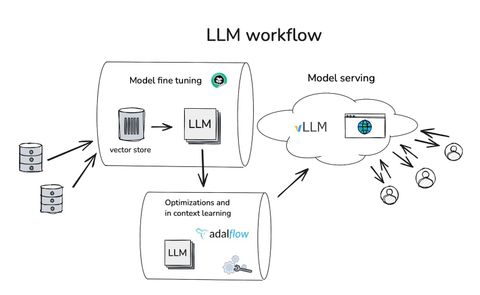
AI Framework Guide: Explore Types, Architecture, Development Tools, Applications & Key Concepts
Artificial intelligence development involves a combination of algorithms, data, computing infrastructure, models and software tools. As AI applications have become more sophisticated, developers increasingly rely on specialized AI frameworks to simplify model development, training, deployment and integration.
An AI framework provides a structured environment for building and managing artificial intelligence applications. Depending on its purpose, a framework may support machine learning, deep learning, natural language processing, computer vision, generative AI or other AI workloads.
Frameworks can provide reusable components for tasks such as data processing, model construction, optimization, training, evaluation and deployment. They can also help developers work with hardware accelerators such as GPUs and specialized AI processors.
This guide explores AI framework types, architecture, development tools, applications, workflows and important concepts.
What Is an AI Framework?
An AI framework is a software framework or library ecosystem designed to help developers create, train, evaluate or deploy artificial intelligence models and applications.
Instead of implementing every mathematical operation and machine-learning component from scratch, developers can use existing framework capabilities.
Depending on the framework, these capabilities may include:
- Model building
- Tensor operations
- Automatic differentiation
- Data processing
- Training loops
- Optimization
- Model evaluation
- GPU acceleration
- Model deployment
- Distributed computing
- Application integration
Why AI Frameworks Are Important
AI development can involve complex mathematical and computational operations. Frameworks provide reusable abstractions that can reduce development complexity.
Important benefits include:
- Faster development
- Reusable components
- Hardware acceleration
- Model experimentation
- Standardized workflows
- Easier deployment
- Community support
- Integration with development tools
AI frameworks are not replacements for understanding machine-learning concepts. Developers still need to understand data, algorithms, model behavior, evaluation and deployment requirements.
Major Types of AI Frameworks
AI frameworks can be categorized according to their primary use.
Machine Learning Frameworks
Machine-learning frameworks support algorithms used to identify patterns in data and make predictions.
Common tasks include:
- Classification
- Regression
- Clustering
- Recommendation
- Anomaly detection
Deep Learning Frameworks
Deep-learning frameworks are designed for neural networks containing multiple computational layers.
They are commonly used for:
- Image recognition
- Speech processing
- Natural language processing
- Generative AI
- Computer vision
Natural Language Processing Frameworks
NLP frameworks support applications involving human language.
Typical applications include:
- Text classification
- Translation
- Summarization
- Question answering
- Sentiment analysis
- Information extraction
Computer Vision Frameworks
Computer-vision frameworks help developers process and analyze images and video.
Applications include:
- Object detection
- Image classification
- Image segmentation
- Facial analysis
- Industrial inspection
Generative AI Frameworks
Generative AI frameworks support applications that generate content such as:
- Text
- Images
- Audio
- Video
- Code
These frameworks may provide model access, orchestration, prompt management, retrieval and application integration capabilities.
Reinforcement Learning Frameworks
Reinforcement-learning frameworks support systems that learn through interactions with an environment.
Applications can include:
- Robotics
- Simulation
- Game AI
- Resource optimization
- Autonomous systems
Popular AI Frameworks and Libraries
The AI ecosystem includes numerous frameworks and libraries, each serving different development requirements.
TensorFlow
TensorFlow is an open-source machine-learning platform used for model development, training and deployment.
It supports neural networks, numerical computation and production-oriented machine-learning workflows.
PyTorch
PyTorch is a widely used open-source machine-learning framework known for its flexible programming model and strong ecosystem.
It is commonly used in:
- Research
- Deep learning
- Computer vision
- NLP
- Generative AI
Scikit-learn
Scikit-learn is a Python machine-learning library focused primarily on traditional machine-learning algorithms.
It supports:
- Classification
- Regression
- Clustering
- Dimensionality reduction
- Model selection
- Preprocessing
Keras
Keras provides a high-level interface for building and training neural networks.
It can simplify the process of creating deep-learning models and is commonly used for experimentation and application development.
JAX
JAX is designed for high-performance numerical computing and machine learning. It provides transformations such as automatic differentiation and compilation for accelerated computing environments.
Hugging Face Ecosystem
The Hugging Face ecosystem provides tools, libraries and model repositories for machine learning and NLP.
It is particularly relevant to:
- Transformer models
- Large language models
- NLP
- Computer vision
- Multimodal AI
AI Framework Architecture
Although architectures differ, many AI frameworks contain several conceptual layers.
Application Layer
This is where developers create the final AI application.
Examples include:
- Chatbots
- Recommendation systems
- Image-analysis applications
- AI assistants
Model Layer
The model layer contains machine-learning or deep-learning models.
Training Layer
This layer manages:
- Training loops
- Optimization
- Loss calculation
- Gradient computation
- Parameter updates
Data Layer
The data layer handles:
- Data loading
- Preprocessing
- Batching
- Transformation
- Dataset management
Hardware Layer
AI frameworks can interact with:
- CPUs
- GPUs
- TPUs
- Specialized AI accelerators
This allows computationally intensive operations to run efficiently.
Core Components of an AI Framework
Tensors
Tensors are multidimensional numerical structures commonly used to represent AI data.
Examples include:
- Images
- Text representations
- Audio features
- Model parameters
Computational Graphs
Some AI frameworks represent mathematical operations as computational graphs.
A graph describes how inputs move through a sequence of operations to produce outputs.
Automatic Differentiation
Automatic differentiation calculates derivatives required for training many machine-learning models.
It reduces the need for developers to manually derive gradients for complex computational operations.
Optimizers
Optimizers adjust model parameters during training.
Examples include:
- Stochastic Gradient Descent
- Adam
- AdamW
- RMSprop
Loss Functions
A loss function measures the difference between a model's prediction and the expected result.
Examples include:
- Mean squared error
- Cross-entropy loss
- Binary cross-entropy
AI Model Development Workflow
A typical AI development workflow can include several stages.
Step 1: Define the Problem
Developers first determine:
- What needs to be predicted?
- What data is available?
- What output is required?
- What performance criteria matter?
Step 2: Collect Data
Data can come from:
- Databases
- Sensors
- Applications
- Public datasets
- Documents
- APIs
Step 3: Prepare Data
Preparation can involve:
- Cleaning
- Normalization
- Transformation
- Labeling
- Deduplication
Step 4: Select a Model
The model depends on the problem and data.
Step 5: Train the Model
Training involves presenting data to the model and adjusting parameters based on the selected optimization process.
Step 6: Evaluate
The model is tested using appropriate evaluation metrics.
Step 7: Optimize
Developers can tune:
- Hyperparameters
- Architecture
- Dataset
- Training process
Step 8: Deploy
The trained model can be deployed through:
- APIs
- Applications
- Cloud services
- Edge devices
- Embedded systems
Step 9: Monitor
Production systems should be monitored for:
- Performance
- Latency
- Errors
- Data changes
- Model drift
AI Framework Development Tools
AI frameworks are commonly used alongside other development tools.
Python
Python is widely used in AI development because of its extensive ecosystem of machine-learning and scientific-computing libraries.
Jupyter
Jupyter environments are commonly used for experimentation, visualization and interactive model development.
Git
Git helps developers manage source-code changes and collaborate on AI projects.
Docker
Docker can package AI applications and their dependencies into portable containers.
Cloud Platforms
Cloud environments can provide:
- GPUs
- Scalable storage
- Model deployment
- Managed machine-learning infrastructure
Development Environments
Developers can work with:
- Local workstations
- Cloud notebooks
- Integrated development environments
- Remote GPU servers
AI Frameworks and GPUs
Training large AI models can require substantial computational resources.
GPUs are particularly useful because they can perform many mathematical operations in parallel.
AI frameworks can use GPU acceleration for:
- Matrix operations
- Neural-network training
- Inference
- Image processing
Frameworks often provide interfaces for moving data and models between CPU and GPU memory.
Model Training
Training is the process of adjusting model parameters based on available data.
A simplified training cycle includes:
Input Data → Model → Prediction → Loss → Gradient → Parameter Update
This process is repeated across many training iterations.
Model Inference
Inference is the process of using a trained model to generate predictions or outputs.
For example:
Input Image → Trained Model → Classification Result
Inference generally differs from training because model parameters are not being updated during normal prediction.
Training vs Inference
| Factor | Training | Inference |
|---|---|---|
| Purpose | Learn patterns | Generate outputs |
| Data | Training dataset | New input |
| Parameter updates | Yes | Generally no |
| Compute requirements | Often higher | Often lower |
| Main objective | Model learning | Prediction |
AI Frameworks for Generative AI
Generative AI introduces additional framework requirements.
These may include:
- Transformer architectures
- Tokenization
- Model serving
- Prompt processing
- Retrieval systems
- Embedding generation
- Fine-tuning
- Evaluation
A generative AI application may contain several connected components.
User → Application → AI Model → Retrieval/Tools → Response
Large Language Model Frameworks
LLM development commonly involves frameworks and libraries that support:
- Model loading
- Tokenization
- Inference
- Fine-tuning
- Prompt management
- Evaluation
- Model serving
LLM applications may also integrate external data sources and software tools.
AI Agents and Frameworks
AI agent systems combine models with tools, memory or workflow logic.
A simplified architecture can be:
User → Agent → LLM → Tool Selection → External System → Result → Response
Agent frameworks may help developers coordinate these components.
Retrieval-Augmented Generation
Retrieval-Augmented Generation combines language models with external information retrieval.
A typical workflow includes:
- User query
- Query processing
- Retrieval
- Relevant information
- Model generation
- Final response
Frameworks can help coordinate retrieval, embeddings, vector databases and LLMs.
AI Frameworks and APIs
APIs allow AI models and applications to communicate with other systems.
An AI API may provide capabilities such as:
- Text generation
- Classification
- Embeddings
- Speech processing
- Image analysis
Frameworks can simplify the integration of these APIs into larger applications.
Model Serving
Model serving makes a trained model available to applications.
A model can be exposed through:
- REST APIs
- gRPC
- Cloud endpoints
- Application servers
- Edge devices
Important serving considerations include:
- Latency
- Throughput
- Scalability
- Availability
- Security
AI Framework Deployment
AI applications can be deployed in different environments.
Cloud Deployment
Cloud infrastructure provides scalable computing resources and managed services.
On-Premises Deployment
Organizations can operate AI workloads within their own infrastructure.
Edge Deployment
Models can run close to where data is generated.
Examples include:
- Cameras
- Industrial devices
- Smartphones
- IoT systems
- Vehicles
Model Optimization
AI frameworks can provide techniques for improving model efficiency.
These can include:
- Quantization
- Pruning
- Compilation
- Knowledge distillation
- Hardware acceleration
Optimization can reduce:
- Memory usage
- Processing time
- Infrastructure requirements
Fine-Tuning
Fine-tuning involves adapting a pretrained model to a particular dataset or task.
It can be used for:
- Domain-specific classification
- Specialized language tasks
- Instruction following
- Industry-specific applications
Fine-tuning requirements vary significantly depending on the model and objective.
Transfer Learning
Transfer learning uses knowledge from an existing trained model for another task.
Instead of training an entire model from scratch, developers can adapt an existing model.
Benefits may include:
- Reduced training requirements
- Faster development
- Lower data requirements for some tasks
AI Framework Evaluation
Choosing an AI framework requires consideration of multiple factors.
Performance
Evaluate:
- Training speed
- Inference speed
- Memory usage
Ecosystem
Consider:
- Libraries
- Documentation
- Community
- Pretrained models
- Integrations
Hardware Support
Check compatibility with:
- CPUs
- GPUs
- TPUs
- AI accelerators
Deployment Options
Consider whether the framework supports the intended production environment.
Development Experience
Factors can include:
- Programming interface
- Debugging tools
- Documentation
- Learning curve
AI Framework Applications
AI frameworks support applications across many industries.
Healthcare
Potential applications include:
- Medical-image analysis
- Research
- Clinical data analysis
- Predictive modeling
Healthcare AI requires careful consideration of privacy, validation and applicable regulations.
Finance
Applications can include:
- Fraud detection
- Risk analysis
- Document processing
- Market analysis
Manufacturing
AI frameworks can support:
- Predictive maintenance
- Quality inspection
- Robotics
- Process optimization
Retail
Applications include:
- Recommendations
- Demand forecasting
- Customer analysis
- Inventory planning
Transportation
AI can support:
- Route optimization
- Driver assistance
- Fleet management
- Predictive maintenance
Education
Applications include:
- Personalized learning
- Content generation
- Assessment support
- Educational analytics
Cybersecurity
AI models can assist with:
- Anomaly detection
- Threat analysis
- Malware classification
- Security monitoring
AI Framework Security
Security should be considered throughout AI development.
Important areas include:
- Data protection
- Access control
- Model security
- API security
- Dependency management
- Infrastructure security
AI applications may also face specialized risks such as:
- Prompt injection
- Data poisoning
- Model extraction
- Adversarial inputs
AI Framework and Data Privacy
AI systems may process sensitive or confidential information.
Developers should consider:
- Data minimization
- Access controls
- Encryption
- Retention policies
- Anonymization
- Regulatory requirements
Privacy requirements vary by application and jurisdiction.
AI Framework Governance
Organizations using AI frameworks at scale may establish governance practices around:
- Model ownership
- Version control
- Dataset management
- Model evaluation
- Access permissions
- Deployment approval
- Monitoring
- Documentation
AI Framework Version Management
Frameworks evolve continuously.
Version management helps organizations control changes to:
- Libraries
- Dependencies
- Models
- APIs
- Hardware drivers
Updating dependencies without testing can cause compatibility problems.
Open-Source vs Proprietary AI Frameworks
AI development environments can include open-source and proprietary technologies.
Open-Source Frameworks
Potential advantages include:
- Source-code visibility
- Community contributions
- Flexibility
- Broad ecosystem
Proprietary Tools
Potential advantages can include:
- Managed infrastructure
- Commercial support
- Integrated services
- Enterprise features
The appropriate choice depends on technical and organizational requirements.
Common AI Framework Challenges
AI framework adoption can introduce challenges.
Complexity
Advanced frameworks may require knowledge of mathematics, programming and machine learning.
Hardware Requirements
Large models can require significant computing resources.
Dependency Management
Frameworks often depend on many supporting libraries.
Model Compatibility
Different frameworks may use different model formats or APIs.
Deployment Complexity
Moving from experimentation to production can require additional infrastructure.
Monitoring
AI models can change in performance as data and operating conditions evolve.
AI Framework Best Practices
Several practices can improve AI development workflows.
Start With a Clear Problem
Define the objective before selecting a framework.
Choose the Simplest Suitable Framework
Avoid unnecessary complexity when a simpler tool meets the requirements.
Use Version Control
Track code, configurations and model-related changes.
Maintain Reproducibility
Record:
- Dataset versions
- Framework versions
- Hyperparameters
- Model configurations
Validate Models
Use appropriate datasets and evaluation metrics.
Monitor Production Systems
Track model performance, latency and operational failures.
Secure Dependencies
Keep frameworks and supporting libraries updated according to organizational security policies.
Document AI Systems
Maintain documentation covering:
- Model purpose
- Data sources
- Training process
- Evaluation
- Deployment
- Limitations
Future Trends in AI Frameworks
AI frameworks continue to evolve alongside advances in computing and model architectures.
Multimodal AI
Frameworks increasingly support models that process combinations of:
- Text
- Images
- Audio
- Video
Smaller AI Models
Efficient models can enable AI capabilities on:
- Mobile devices
- Edge hardware
- Personal computers
- Embedded systems
AI Agent Frameworks
More frameworks are supporting systems that combine models with tools, memory and external applications.
Automated Machine Learning
AutoML technologies can automate parts of:
- Feature engineering
- Model selection
- Hyperparameter tuning
- Evaluation
Specialized AI Hardware
Frameworks are increasingly adapting to specialized accelerators designed for AI workloads.
Model Optimization
Efficient inference, quantization and compilation are becoming increasingly important as AI models grow in complexity.
AI Framework Learning Path
A structured learning pathway can help beginners build practical knowledge.
Stage 1: Programming Fundamentals
Learn:
- Python
- Data structures
- Functions
- Object-oriented programming
- Package management
Stage 2: Mathematics
Study:
- Linear algebra
- Probability
- Statistics
- Calculus fundamentals
Stage 3: Machine Learning
Learn:
- Regression
- Classification
- Clustering
- Model evaluation
Stage 4: Deep Learning
Explore:
- Neural networks
- Convolutional networks
- Transformers
- Optimization
Stage 5: Framework Development
Practice with frameworks such as:
- TensorFlow
- PyTorch
- Scikit-learn
- Keras
- JAX
Stage 6: Deployment
Learn:
- APIs
- Containers
- Cloud infrastructure
- Model serving
- Monitoring
Stage 7: Advanced AI
Explore:
- Generative AI
- LLMs
- RAG
- AI agents
- Multimodal systems
AI Framework Comparison
| Framework/Library | Primary Area | Common Use |
|---|---|---|
| TensorFlow | Machine Learning/Deep Learning | Model development and deployment |
| PyTorch | Deep Learning | Research and production AI |
| Scikit-learn | Machine Learning | Traditional ML |
| Keras | Deep Learning | Neural-network development |
| JAX | Numerical Computing/ML | High-performance computation |
| Hugging Face Ecosystem | Transformers/AI | NLP, LLMs and multimodal models |
These technologies serve different purposes and may be used together within a broader AI development ecosystem.
AI Framework Checklist
Before selecting or implementing an AI framework, consider:
- AI problem clearly defined
- Data requirements identified
- Framework capabilities evaluated
- Hardware requirements reviewed
- Development language considered
- Model compatibility checked
- Deployment environment identified
- Security requirements documented
- Evaluation metrics defined
- Monitoring requirements established
- Version management planned
- Documentation prepared
Frequently Asked Questions
What is an AI framework?
An AI framework is a software framework or library ecosystem that provides tools and components for developing, training, evaluating or deploying artificial intelligence models and applications.
What are the main types of AI frameworks?
Major categories include machine-learning frameworks, deep-learning frameworks, NLP frameworks, computer-vision frameworks, generative-AI frameworks and reinforcement-learning frameworks.
Which programming language is commonly used with AI frameworks?
Python is widely used because of its extensive machine-learning, scientific-computing and data-processing ecosystem. Other languages can also be used depending on the framework and application.
What is the difference between an AI framework and an AI model?
An AI framework provides the development infrastructure and tools used to build or operate models. An AI model is the trained computational system that produces predictions or outputs.
What is PyTorch used for?
PyTorch is commonly used for machine learning and deep learning, including research, computer vision, NLP and generative AI applications.
What is TensorFlow used for?
TensorFlow provides tools for developing, training and deploying machine-learning models and can support production-oriented AI workflows.
What is Scikit-learn used for?
Scikit-learn is primarily used for traditional machine-learning tasks such as classification, regression, clustering, preprocessing and model evaluation.
What is model inference?
Model inference is the process of using a trained AI model to generate a prediction or output from new input data.
What is fine-tuning?
Fine-tuning adapts an existing pretrained model using additional training data for a particular task or domain.
What is transfer learning?
Transfer learning uses knowledge learned by an existing model as a starting point for another related task.
Why are GPUs important for AI?
GPUs can perform large numbers of mathematical operations in parallel, making them useful for computationally intensive AI workloads.
Can AI frameworks be used for generative AI?
Yes. AI frameworks and supporting ecosystems can be used to develop generative AI applications involving language, images, audio, video and multimodal data.
What is an AI framework architecture?
AI framework architecture describes the layers and components involved in developing and operating AI systems, including data processing, models, training, optimization, hardware acceleration and deployment.
How should an AI framework be selected?
Selection can depend on the AI task, programming environment, available hardware, ecosystem, model compatibility, deployment requirements, performance and organizational needs.
Conclusion
AI frameworks provide the technical foundation for building many modern artificial intelligence applications. They simplify complex tasks such as tensor computation, model training, automatic differentiation, optimization, hardware acceleration and deployment.
Different frameworks are designed for different purposes. PyTorch, TensorFlow, Scikit-learn, Keras, JAX and the Hugging Face ecosystem represent important parts of the broader AI development landscape, although their capabilities and intended uses differ.
The growth of generative AI, large language models, multimodal systems and AI agents is also expanding the role of AI frameworks. Modern development increasingly involves not only model training but also APIs, retrieval systems, deployment infrastructure, monitoring and application integration.
A practical approach to learning AI frameworks starts with programming and machine-learning fundamentals before moving into deep learning, model development and deployment. Understanding the underlying concepts is valuable because frameworks change over time, while core principles such as data preparation, model evaluation, optimization and responsible deployment remain fundamental.
Ultimately, the most suitable AI framework depends on the problem being solved, data requirements, model architecture, hardware environment, development experience and deployment objectives.
Disclaimer: This article is provided for general educational and informational purposes only. AI frameworks, libraries, models, APIs and development tools change frequently. Readers should consult current official documentation and technical resources before selecting technologies for production systems. AI applications may also involve privacy, security, regulatory and ethical considerations that should be evaluated according to the specific use case.

Lavit
Our content is designed to attract, persuade, and convert your audience. We help brands grow through strategic, audience-first writing.
August 13, 2026 . 9 min read
Related Post...
Real Estate CRM Knowledge Hub: Learn Client Management Tips, Feature & Expert Information
By: Lavit
Updated: August 28, 2026
Read More
AI Framework Guide: Explore Types, Architecture, Development Tools, Applications & Key Concepts
By: Lavit
Updated: August 13, 2026
Read More
Latest Automotive Technology Guide: Explore EVs, AI, ADAS, Connected Cars & Future Mobility
By: Lavit
Updated: August 11, 2026
Read More