ECG Equipment Guide: Explore Machines, Electrodes, Leads, Monitoring & Recording
Electrocardiography is an important part of modern cardiac assessment and monitoring. ECG equipment encompasses the devices and accessories used to detect, record, display and manage the electrical activity of the heart.
A typical ECG setup may include an electrocardiograph machine, patient cable, lead wires and electrodes. More advanced systems can include digital displays, printers, internal storage, wireless connectivity and integration with electronic healthcare systems.
Different ECG equipment configurations are designed for different environments. A portable system may be useful for bedside or mobile assessments, while a full-featured multi-channel electrocardiograph can support clinical departments and diagnostic workflows.
This guide explains ECG machines, electrodes, leads, monitoring systems, recording methods, components, signal quality, maintenance and important selection considerations.
What Is ECG Equipment?
ECG equipment refers to the collection of devices and accessories used to acquire and manage electrocardiographic signals.
Depending on the application, an ECG setup can include:
- ECG machine or electrocardiograph
- ECG electrodes
- Lead wires
- Patient cables
- Signal amplifiers
- Displays
- ECG printers
- Batteries
- Digital storage
- Communication interfaces
- Monitoring accessories
The exact configuration depends on the type of ECG recording or monitoring required.
What Is an ECG Machine?
An ECG machine, or electrocardiograph, is the primary device used to record the heart's electrical activity.
The machine receives signals through electrodes attached to the body. Because cardiac electrical signals are relatively small, the equipment amplifies and processes them before presenting the information as ECG waveforms.
A basic signal path is:
Heart
  ↓
Electrodes
  ↓
Lead Wires
  ↓
Patient Cable
  ↓
ECG Machine
  ↓
Signal Processing
  ↓
Display / Print / Storage
How ECG Equipment Works
The fundamental process involves detecting electrical differences between specific points on the body.
Signal Acquisition
Electrodes detect electrical activity at the skin surface.
Signal Transmission
Lead wires carry the electrical signals from the electrodes to the ECG machine.
Signal Amplification
The machine amplifies the small signals to make them suitable for processing.
Signal Filtering
Electronic filtering can reduce certain types of interference and unwanted noise.
Signal Processing
The device processes the acquired signals and converts them into ECG waveforms.
Display and Recording
The final tracing can be displayed on a screen, printed on paper or stored digitally.
ECG Electrodes
ECG electrodes are conductive sensors that establish electrical contact between the patient's skin and the ECG system.
They are available in several configurations, including:
- Disposable adhesive electrodes
- Reusable electrodes
- Pre-gelled electrodes
- Snap-style electrodes
- Clip-style electrodes
- Specialty monitoring electrodes
Electrode design and compatibility vary between systems.
Disposable ECG Electrodes
Disposable electrodes are commonly used in clinical environments where single-patient use is preferred.
They typically include:
- Adhesive backing
- Conductive surface
- Conductive gel
- Connector
- Protective backing
Disposable electrodes can help simplify preparation and reduce the need for electrode cleaning between patients.
Reusable ECG Electrodes
Some ECG systems use reusable electrodes.
These may require:
- Cleaning
- Disinfection
- Inspection
- Proper storage
- Regular replacement when degraded
The cleaning procedure should follow the electrode manufacturer's instructions and applicable healthcare protocols.
ECG Lead Wires
Lead wires connect the physical electrodes to the patient cable or ECG machine.
They must maintain reliable electrical connections while also being flexible enough for practical clinical use.
Important characteristics can include:
- Connector design
- Cable length
- Flexibility
- Durability
- Electrical shielding
- Compatibility with the ECG system
Damaged or poorly connected lead wires can contribute to signal artifacts.
ECG Patient Cable
The patient cable is the interface between multiple lead wires and the ECG machine.
A standard diagnostic ECG cable may connect several electrodes to the electrocardiograph.
Cable configurations depend on the number of electrodes and leads supported by the equipment.
ECG Leads
An ECG lead represents a specific electrical view of the heart.
A lead is not simply the same thing as a physical electrode.
Electrodes detect electrical signals at particular body locations, while leads are calculated or derived electrical views based on differences between those signals.
Understanding this distinction is important when discussing 12-lead ECG systems.
Standard 12-Lead ECG
A standard 12-lead ECG typically uses 10 physical electrodes to generate 12 electrical leads.
The 12 leads include:
Three standard limb leads:
- Lead I
- Lead II
- Lead III
Three augmented limb leads:
- aVR
- aVL
- aVF
Six chest leads:
- V1
- V2
- V3
- V4
- V5
- V6
Together, these provide multiple electrical perspectives of cardiac activity.
Limb Electrodes
Limb electrodes are associated with the arms and legs.
The standard arrangement includes:
- Right arm
- Left arm
- Right leg
- Left leg
The right-leg connection commonly provides a reference or ground function in many ECG systems.
Correct placement is important for obtaining an appropriate tracing.
Chest Electrodes
Chest or precordial electrodes are identified as:
- V1
- V2
- V3
- V4
- V5
- V6
They are positioned at specific anatomical locations across the chest.
Accurate placement is important because moving an electrode from its intended location can change the resulting ECG waveform.
ECG Monitoring Equipment
ECG monitoring equipment is designed to observe cardiac electrical activity continuously or over extended periods.
Common categories include:
- Bedside patient monitors
- Telemetry systems
- Holter monitors
- Event monitors
- Ambulatory ECG systems
- Portable monitoring devices
The appropriate system depends on the duration and purpose of monitoring.
Bedside ECG Monitoring
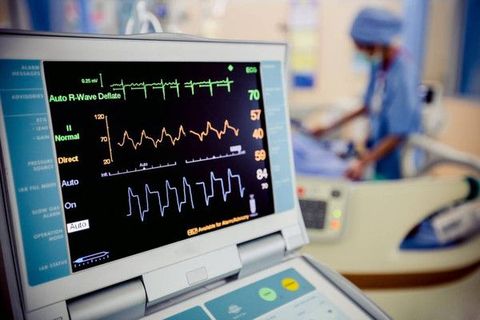
Hospital bedside monitors can continuously display ECG information along with other physiological measurements.
Depending on the system, a bedside monitor may display:
- ECG waveform
- Heart rate
- Oxygen saturation
- Blood pressure
- Respiratory information
- Other physiological parameters
The exact capabilities vary by monitor configuration.
Telemetry ECG Monitoring
Telemetry enables ECG information to be transmitted from a patient-worn or bedside device to a monitoring station.
A simplified architecture is:
Patient
  ↓
ECG Electrodes
  ↓
Portable Transmitter
  ↓
Wireless Network
  ↓
Central Monitoring Station
Telemetry can allow authorized clinical personnel to observe ECG information from a central location.
Holter Monitoring
A Holter monitor is a portable ambulatory ECG system designed to record cardiac electrical activity over an extended period.
Compared with a short resting ECG, Holter monitoring provides a longer window for observing intermittent rhythm patterns.
Event Monitoring
Event monitors can be used for longer-term monitoring in situations where symptoms or rhythm changes may occur intermittently.
Depending on the device, recording may be triggered automatically or by the user.
Portable ECG Equipment
Portable ECG equipment is designed for mobility.
Potential environments include:
- Clinics
- Hospital wards
- Emergency settings
- Ambulances
- Community healthcare
- Remote clinical environments
Important design considerations may include:
- Weight
- Battery capacity
- Display
- Durability
- Number of channels
- Connectivity
- Storage
Types of ECG Machines
Single-Channel ECG Devices
These systems record a limited number of ECG signals and can have compact designs.
3-Channel ECG Machines
These systems can display or print multiple ECG channels simultaneously.
6-Channel ECG Machines
Six-channel configurations can process multiple ECG signals at the same time and may be used in clinical environments requiring broader waveform presentation.
12-Channel ECG Machines
12-channel systems can acquire and display the standard ECG leads in a clinical diagnostic workflow.
Portable ECG Machines
Portable electrocardiographs prioritize mobility and may use rechargeable batteries.
Digital ECG Systems
Digital ECG systems process, store and transmit ECG information electronically.
ECG Recording Methods
ECG equipment can support different recording approaches.
Resting ECG
A resting ECG records cardiac electrical activity while the patient remains still.
Exercise ECG
An exercise ECG records cardiac electrical activity while the patient exercises under appropriate clinical supervision.
Continuous ECG
Continuous systems record cardiac electrical activity for an extended period.
Ambulatory ECG
Ambulatory systems allow ECG recording while the person performs normal daily activities.
ECG Recording Paper
Traditional ECG machines commonly use thermal paper for printed ECG traces.
The paper provides a physical record containing information such as:
- Patient identification
- Date and time
- Lead labels
- ECG waveforms
- Recording settings
- Heart rate or measurements where supported
Modern systems may provide both paper and digital records.
Digital ECG Recording
Digital ECG equipment can store recordings electronically.
Depending on the system, digital records may support:
- Internal storage
- USB export
- Network transfer
- Wireless communication
- Electronic health-record integration
- Digital printing
- Data archiving
ECG Machine Components
A typical ECG machine can include several important components.
Display
The display provides real-time or recorded waveform visualization.
Amplifier
The amplifier increases the magnitude of the acquired electrical signal while maintaining waveform characteristics.
Filters
Filters help reduce specific sources of electrical interference.
Processor
A digital processor manages signal acquisition, processing and other device functions.
Printer
Some clinical ECG systems include integrated thermal printers.
Memory
Memory allows ECG records and patient information to be stored.
Battery
Battery-powered systems support mobile use.
Control Interface
Buttons, touchscreens or other controls allow users to configure and operate the device.
ECG Signal Quality
High-quality ECG recording depends on multiple factors.
These can include:
- Correct electrode placement
- Good skin contact
- Appropriate electrode condition
- Proper cable connections
- Minimal patient movement
- Appropriate equipment configuration
- Reduced electrical interference
A technically advanced ECG system cannot compensate for every source of poor signal acquisition.
Common ECG Artifacts
An artifact is an unwanted signal or distortion that affects an ECG tracing.
Common sources include:
Baseline Wander
The ECG baseline moves slowly up and down.
Possible causes include:
- Breathing
- Movement
- Poor electrode adhesion
- Cable movement
Muscle Artifact
Muscle activity can introduce electrical signals into the ECG recording.
Electrical Interference
Power-line interference and nearby electrical equipment can contribute to unwanted noise.
Electrode Movement
Movement of an electrode can change electrical contact and introduce unstable signals.
Cable Problems
Damaged or improperly connected cables can also contribute to signal quality issues.
ECG Skin Preparation
Appropriate skin preparation can improve electrode contact.
Depending on clinical protocol, preparation may involve:
- Cleaning the skin.
- Ensuring the area is dry.
- Managing excessive hair where necessary.
- Applying compatible electrodes correctly.
- Confirming stable contact before recording.
Healthcare personnel should follow applicable clinical procedures and manufacturer instructions.
ECG Machine Safety
ECG equipment is designed with electrical and patient-safety considerations.
Important areas include:
- Electrical isolation
- Patient protection
- Cable condition
- Equipment grounding
- Approved accessories
- Routine inspection
- Cleaning procedures
- Maintenance schedules
Healthcare facilities should follow applicable regulatory requirements, institutional policies and manufacturer instructions.
ECG Equipment Maintenance
Routine maintenance can help support reliable equipment operation.
General maintenance activities can include:
- Inspecting cables
- Checking connectors
- Inspecting electrodes
- Cleaning equipment surfaces
- Checking battery condition
- Reviewing printer function
- Performing required performance checks
- Updating software where applicable
Maintenance schedules vary by equipment type and manufacturer.
ECG Equipment Connectivity
Modern ECG equipment can provide several connectivity options.
These may include:
- USB
- Ethernet
- Wi-Fi
- Bluetooth
- Local networks
- Healthcare information-system interfaces
Connectivity allows ECG information to move from the acquisition device to other authorized systems.
ECG Data Management
Digital ECG records may contain patient-related information and therefore require appropriate data-management practices.
Features can include:
- Patient identification
- Record storage
- Search
- Export
- Data transmission
- Digital archiving
- Electronic record integration
Organizations should apply appropriate privacy, access-control and security measures when managing patient information.
ECG Equipment in Different Healthcare Settings
Hospitals
Hospitals may use ECG equipment across:
- Emergency departments
- Cardiology units
- Intensive care areas
- General wards
- Diagnostic departments
- Operating environments
Clinics
Clinics may use compact ECG systems for routine examinations and diagnostic workflows.
Emergency Medical Services
Portable ECG equipment can support assessment in ambulances and other mobile environments.
Diagnostic Centers
Diagnostic facilities may use multi-channel ECG machines with printing, storage and electronic data-transfer capabilities.
Remote Healthcare
Portable and connected ECG devices may support selected remote-monitoring workflows where appropriate clinical infrastructure is available.
ECG Equipment Selection Factors
Healthcare organizations evaluating ECG equipment can consider several factors.
Intended Use
Determine whether the equipment is intended for:
- Resting ECG
- Monitoring
- Exercise testing
- Ambulatory recording
- Emergency use
Channel Configuration
The required number of channels depends on the intended application.
Portability
Mobile applications may require lightweight equipment and battery operation.
Display
A clear screen can make waveform monitoring easier.
Printing
An integrated printer may be useful when physical ECG records are required.
Storage
Internal storage can allow recordings to be retained before transfer.
Connectivity
Connectivity options can influence integration with existing digital workflows.
Electrode Compatibility
Electrodes and cables should be compatible with the selected equipment.
Battery Life
Battery capacity can be important for portable systems.
Maintenance
Organizations should consider cleaning, inspection and maintenance requirements.
ECG Equipment Comparison
| Equipment Type | Typical Purpose | Portability | Recording Duration |
|---|---|---|---|
| Resting ECG Machine | Short diagnostic ECG | Moderate | Short |
| Portable ECG | Mobile ECG recording | High | Short |
| Bedside Monitor | Continuous observation | Low to moderate | Extended |
| Telemetry System | Centralized monitoring | High at patient end | Extended |
| Holter Monitor | Ambulatory recording | High | Extended |
| Event Monitor | Intermittent monitoring | High | Long-term, device-dependent |
ECG Machine vs ECG Monitor
An ECG machine generally focuses on acquiring and recording an electrocardiogram, often as a dedicated diagnostic procedure.
An ECG monitor is generally designed for ongoing observation of cardiac electrical activity.
Many modern patient monitors also include ECG as one of several physiological measurements.
ECG Machine vs Holter Monitor
A standard ECG generally captures a short recording.
A Holter monitor is designed to record ECG information for a much longer period during normal daily activity.
The choice depends on the clinical objective and monitoring requirements.
ECG Leads vs Electrodes
These terms are frequently confused.
Electrodes are physical sensors attached to the body.
Leads are electrical views of the heart generated from electrode signals.
For a standard 12-lead ECG:
- 10 physical electrodes are used.
- 12 electrical leads are produced.
ECG Equipment and Clinical Applications
ECG equipment can support various clinical activities, including:
- Cardiac rhythm assessment
- Heart-rate measurement
- Evaluation of electrical conduction
- Monitoring during acute care
- Exercise testing
- Preoperative evaluation when clinically indicated
- Ambulatory rhythm recording
- Ongoing cardiac monitoring
The appropriate ECG method depends on the clinical situation and professional assessment.
Modern ECG Equipment Features
Contemporary systems may include:
- Touchscreen controls
- Digital displays
- Automated measurements
- Internal memory
- Integrated printers
- Wireless communication
- Network connectivity
- Electronic record integration
- Portable battery operation
- Data export
Not every ECG machine includes all of these capabilities.
AI and ECG Equipment
Artificial intelligence and machine-learning technologies are increasingly being explored for ECG analysis.
Potential applications include:
- Waveform classification
- Pattern recognition
- Automated measurements
- Signal-quality assessment
- Decision-support research
- Identification of certain ECG patterns
AI-based ECG analysis should be evaluated according to its intended clinical purpose, validation evidence, regulatory status and professional oversight.
Future Developments in ECG Equipment
Several trends are influencing the development of ECG technology.
Smaller Devices
Advances in electronics can support increasingly compact ECG equipment.
Wireless Systems
Wireless connectivity can simplify data transfer and reduce physical cabling in appropriate environments.
Digital Integration
ECG systems are increasingly designed to work with electronic healthcare environments.
Remote Monitoring
Connected devices can support longer-distance monitoring workflows where appropriate.
Intelligent Signal Processing
Advanced algorithms can help process ECG signals and identify certain waveform characteristics.
ECG Equipment Checklist
Before implementing an ECG system, organizations can review:
- Intended application
- Channel configuration
- Electrode type
- Lead configuration
- Display requirements
- Printing requirements
- Digital storage
- Connectivity
- Battery operation
- Data security
- Maintenance requirements
- Cleaning procedures
- Equipment compatibility
- Staff training
- Applicable regulatory requirements
Frequently Asked Questions
What is ECG equipment?
ECG equipment includes electrocardiograph machines, electrodes, lead wires, patient cables, monitors and related accessories used to acquire, record, display or monitor cardiac electrical activity.
What are the main components of an ECG setup?
A basic setup includes an ECG machine, electrodes, lead wires and a patient cable. Advanced systems may also include displays, printers, batteries, storage and connectivity components.
How many electrodes are used for a 12-lead ECG?
A standard 12-lead ECG generally uses 10 physical electrodes to generate 12 electrical leads.
What is the difference between an ECG lead and an electrode?
An electrode is a physical sensor attached to the body. A lead represents a particular electrical view of the heart derived from electrode signals.
What types of ECG machines are available?
Common types include single-channel, 3-channel, 6-channel, 12-channel and portable ECG machines. Monitoring and ambulatory systems are also used for longer recording periods.
What is a Holter monitor?
A Holter monitor is a portable ambulatory ECG device designed to record cardiac electrical activity continuously over an extended period.
Why is electrode placement important?
Electrode placement determines the electrical perspective captured by the ECG. Incorrect placement can alter the resulting tracing.
What can cause ECG artifacts?
Patient movement, muscle activity, poor electrode contact, cable movement and electrical interference can contribute to artifacts.
Can ECG machines store data digitally?
Many modern ECG systems can store recordings electronically and may support transfer through USB, networks or other supported interfaces.
Can ECG equipment connect to electronic health records?
Some ECG systems support integration with electronic healthcare systems through supported network or data-transfer interfaces.
How should ECG equipment be maintained?
Maintenance can include cable inspection, cleaning, battery checks, connector inspection and required performance testing. Specific procedures should follow manufacturer and institutional requirements.
Can ECG equipment be used for continuous monitoring?
Dedicated ECG monitors, telemetry systems and ambulatory devices can provide extended or continuous ECG monitoring depending on their design.
Conclusion
ECG equipment combines electrocardiograph machines, electrodes, leads, patient cables, monitoring systems and recording technologies to capture the electrical activity of the heart.
The basic process begins with electrodes detecting electrical signals, followed by transmission through lead wires and patient cables to the ECG machine. The device then amplifies and processes the signals before displaying, printing or digitally storing the resulting waveform.
Different equipment types serve different purposes. Resting ECG machines are designed for short recordings, while bedside monitors, telemetry systems and Holter devices can support longer periods of observation. Portable ECG systems add flexibility for mobile environments.
When evaluating ECG equipment, organizations can consider intended use, channel configuration, electrode compatibility, portability, display, storage, connectivity, battery operation, maintenance and data-management requirements. Correct electrode placement and good signal-acquisition practices are equally important for obtaining useful ECG recordings.
Modern ECG technology is also moving toward greater digital integration, wireless connectivity, remote monitoring and algorithm-assisted analysis, making ECG equipment an increasingly connected component of healthcare technology.
Disclaimer: This article is intended for general educational and informational purposes only. It does not provide medical diagnosis or individualized medical advice. ECG recordings should be obtained and interpreted by appropriately qualified healthcare professionals, and ECG equipment should be used according to applicable clinical procedures, manufacturer instructions and relevant regulatory requirements.

Lavit
Our content is designed to attract, persuade, and convert your audience. We help brands grow through strategic, audience-first writing.
August 26, 2026 . 9 min read
Related Post...
ECG Machine Guide: Explore How It Works, Types, Components, Electrodes & Clinical Applications
By: Lavit
Updated: August 26, 2026
Read More
Black Water and Alkaline Water Guide: Explore Types, Differences, Properties & Potential Health Benefit
By: Lavit
Updated: September 17, 2026
Read More
CPAP Machine Guide: Explore How It Works, Types, Features, Masks & Sleep Therapy Basics
By: Lavit
Updated: August 26, 2026
Read More