Electric Vehicles Explained: A Complete Guide to Technology, Types & Everyday Use
Electric vehicles (EVs) are changing how people think about personal and commercial transportation. Instead of relying entirely on petrol or diesel engines, these vehicles use electric motors powered by energy stored in batteries or generated through other electric power systems.
Electric mobility includes cars, scooters, motorcycles, buses, three-wheelers and commercial vehicles. Some operate entirely on electricity, while others combine an electric motor with a conventional engine.
Understanding electric vehicle technology involves more than knowing how to charge a battery. It also includes learning about motor operation, battery management, charging infrastructure, driving range, maintenance and the practical considerations of everyday use.
This guide explains the fundamentals of electric vehicles and how different technologies fit into modern transportation.
1. What Is an Electric Vehicle?
An electric vehicle is a mode of transportation that uses one or more electric motors to provide propulsion. In a battery-electric vehicle, rechargeable batteries store the energy required to operate the motor.
Unlike a conventional internal combustion engine vehicle, a battery-electric vehicle does not burn petrol or diesel to move. It receives electricity from an external charging source and stores that energy in its battery pack.
The main characteristics of electric vehicles include:
Electric motors provide movement.
Rechargeable batteries store electrical energy.
Power electronics control the flow of electricity.
Charging equipment connects compatible vehicles to an electrical source.
Regenerative braking can recover some energy during deceleration.
Battery-electric vehicles produce no exhaust emissions from a tailpipe while driving. However, electricity generation, battery production and vehicle manufacturing can still create environmental impacts.
2. How Does Electric Vehicle Technology Work?
Electric vehicles use a combination of electrical, electronic and mechanical systems to convert stored energy into movement.
The basic operating process begins when the driver presses the accelerator. The vehicle's control system interprets the input and determines how much power the motor should receive.
The battery supplies electrical energy through power electronics, which regulate the electricity delivered to the motor. The motor then produces rotational force that moves the wheels.
Main Working Stages
Energy storage: The battery pack stores electrical energy.
Driver input: Accelerator movement communicates the required power level.
Power conversion: The inverter and associated electronics regulate electrical energy supplied to the motor.
Motor operation: The electric motor produces rotational movement.
Wheel movement: The drivetrain transfers motor output to the wheels.
Energy recovery: Regenerative braking can convert part of the vehicle's movement energy back into electricity.
This process allows an electric vehicle to operate without the engine, fuel tank and exhaust system found in conventional petrol or diesel vehicles.
3. Main Components of an Electric Vehicle
An electric vehicle contains several interconnected components. Each has a specific function in storing, controlling and using electrical energy.
| Component | Main Function |
|---|---|
| Battery pack | Stores electrical energy for vehicle operation |
| Electric motor | Converts electrical energy into mechanical movement |
| Inverter | Converts battery DC power into AC power where required by the motor |
| Battery Management System (BMS) | Monitors battery conditions and manages charging and discharging |
| Vehicle Control Unit | Coordinates important electronic systems |
| Onboard charger | Converts incoming AC electricity into DC for battery charging |
| DC-DC converter | Supplies lower-voltage electrical systems |
| Thermal management system | Helps regulate battery and powertrain temperature |
| Charging port | Provides the connection for external charging |
| Reduction gearbox | Transfers motor power to the wheels at suitable speeds |
The exact arrangement depends on vehicle design. Some electric vehicles use one motor, while others use two or more motors to provide different driving characteristics.
4. Different Types of Electric Vehicles
Electric vehicles are available in several configurations. The main difference is how each vehicle stores energy and whether it uses a conventional combustion engine.
Battery Electric Vehicles (BEVs)
Battery Electric Vehicles operate entirely through electricity stored in rechargeable battery packs.
They do not have a petrol or diesel engine. The battery supplies power to the electric motor, and the vehicle is recharged through an external electrical connection.
Common characteristics include:
Fully electric propulsion
External battery charging
No tailpipe emissions during operation
Regenerative braking
Battery-dependent driving range
Electric cars, electric scooters and many electric buses use this technology.
Hybrid Electric Vehicles (HEVs)
Hybrid Electric Vehicles combine a conventional internal combustion engine with an electric motor and a battery.
The electric motor assists the engine during certain driving conditions. The battery is generally charged through regenerative braking and the vehicle's engine-driven charging system rather than an external charging connection.
HEVs are designed to improve energy efficiency while continuing to use conventional fuel.
Plug-in Hybrid Electric Vehicles (PHEVs)
Plug-in Hybrid Electric Vehicles combine an electric motor, rechargeable battery and conventional engine.
Unlike standard hybrids, PHEVs can be connected to an external charging source. They can travel in electric mode for a limited distance before the combustion engine becomes necessary.
Their operation depends on the battery charge, vehicle design and driving conditions.
Fuel Cell Electric Vehicles (FCEVs)
Fuel Cell Electric Vehicles use hydrogen to generate electricity through a fuel cell. That electricity powers an electric motor.
Hydrogen is stored in dedicated tanks and supplied to the fuel cell, where an electrochemical process produces electricity. Water is the main direct by-product of this process.
FCEVs require specialised hydrogen refuelling infrastructure and are different from battery-electric vehicles that receive electricity from a charging point.
5. Electric Vehicle Battery Technology
The battery is one of the most important parts of a battery-electric vehicle. It determines how much electrical energy the vehicle can store and influences its driving range, charging requirements and overall performance.
Modern electric vehicles commonly use lithium-ion battery technology. However, different battery chemistries are available, each with its own characteristics.
Common Battery Types
Lithium Iron Phosphate (LFP): LFP batteries are known for their thermal stability and durability characteristics. They are used in several electric vehicle applications.
Nickel Manganese Cobalt (NMC): NMC batteries combine nickel, manganese and cobalt. Their energy density makes them suitable for applications where battery capacity and packaging are important.
Nickel Cobalt Aluminium (NCA): NCA batteries use nickel, cobalt and aluminium and are another lithium-ion battery chemistry used in electric mobility.
Sodium-Ion Batteries: These batteries use sodium-based chemistry rather than lithium. They are being developed and introduced for selected applications, although their suitability depends on factors such as energy density, temperature performance and application requirements.
What Is a Battery Management System?
A Battery Management System monitors and manages important battery functions.
Its responsibilities commonly include:
Monitoring cell voltage and temperature
Managing charging and discharging limits
Balancing battery cells
Detecting abnormal operating conditions
Supporting battery protection
Communicating battery information to vehicle control systems
Battery management is important because battery performance and safety depend on operating within suitable electrical and temperature limits.
6. Electric Vehicle Charging Methods
Charging is an essential part of everyday electric vehicle use. Different charging methods are available depending on the vehicle, charger rating and electrical connection.
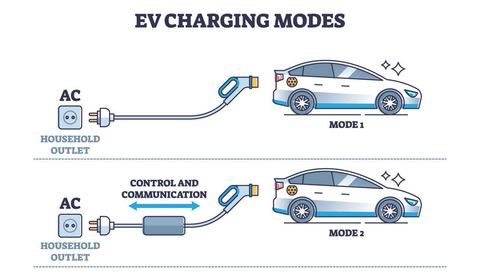
AC Charging
Alternating Current (AC) charging supplies electricity to the vehicle through compatible charging equipment.
The vehicle's onboard charger converts AC electricity into DC power for the battery. Charging speed depends on the onboard charger's capacity, the external supply and the battery's charging limits.
AC charging is commonly used at homes, workplaces and selected public charging locations.
DC Fast Charging
Direct Current (DC) fast charging supplies DC electricity to the battery through compatible external charging equipment.
The conversion from AC to DC is performed by the charging station rather than the vehicle's onboard AC charger. This allows higher charging power when supported by the vehicle and charging infrastructure.
Charging speed can change during a session depending on battery temperature, state of charge and other operating conditions.
Home Charging
Home charging allows vehicle owners to recharge their vehicles at a residential location using compatible electrical equipment.
Before installing a charging point, it is important to consider:
Electrical connection capacity
Wiring and protective equipment
Earthing and installation quality
Charger compatibility
Parking location and cable arrangement
Applicable electrical and building requirements
A qualified electrical professional should assess the installation rather than relying on assumptions about household wiring.
Public Charging
Public charging facilities are installed at locations such as parking areas, commercial buildings, highways and transport hubs.
They can provide AC or DC charging depending on the installation. Drivers should check connector compatibility, charging power, operating conditions and payment arrangements before starting a session.
7. What Is Regenerative Braking?
Regenerative braking is a technology that allows an electric motor to recover some energy when the vehicle slows down.
During acceleration, the motor uses electrical energy to move the vehicle. During suitable deceleration conditions, the motor can operate as a generator and convert some of the vehicle's kinetic energy into electrical energy.
This recovered energy is returned to the battery.
Regenerative braking is particularly useful in traffic conditions involving repeated slowing and acceleration. However, the amount of energy recovered depends on vehicle design, speed, battery condition and driving conditions.
It does not replace conventional friction brakes. The vehicle still requires a mechanical braking system for reliable stopping.
8. Electric Vehicle Driving Range and Performance
Driving range refers to the distance an electric vehicle can travel using the energy available in its battery.
Range varies between vehicles because of differences in battery capacity, motor efficiency, vehicle weight, aerodynamics and software controls.
Several factors influence actual driving range:
Driving speed: Higher speeds generally require more energy.
Weather: Very hot or cold conditions can affect battery performance and climate-control energy use.
Air conditioning: Heating and cooling systems consume electrical energy.
Driving style: Rapid acceleration and aggressive driving can increase energy consumption.
Road conditions: Hills, traffic and road surfaces can influence efficiency.
Vehicle load: Additional passengers and luggage can increase energy requirements.
Tyre condition: Incorrect tyre pressure can reduce efficiency.
The driving range displayed by a vehicle is an estimate. Actual distance may differ depending on how and where the vehicle is driven.
9. Everyday Uses of Electric Vehicles
Electric vehicles are used across several transportation categories. Their suitability depends on the distance travelled, vehicle type, charging access and operating requirements.
Personal Transportation
Electric cars, scooters and motorcycles are used for commuting, shopping and other regular journeys.
For people with predictable travel patterns and convenient charging access, battery-electric vehicles can fit into everyday routines.
Public Transportation
Electric buses are used in urban transportation systems. They can operate on planned routes with charging arrangements at depots or selected locations.
Their operation requires coordination between vehicle range, passenger capacity, charging schedules and route planning.
Commercial Transportation
Electric three-wheelers, delivery vehicles and selected light commercial vehicles are used for goods movement and local transportation.
Businesses may evaluate these vehicles based on daily distance, payload requirements, charging access and operating schedules.
Shared Mobility
Electric vehicles can also be used in shared transportation, rental fleets and other mobility arrangements.
Their practical use depends on vehicle availability, charging management, maintenance arrangements and the travel requirements of users.
10. Benefits and Limitations of Electric Vehicles
Electric vehicles have several technical characteristics that make them useful in modern transportation. However, they also involve limitations that should be considered.
Potential Benefits
No tailpipe emissions from battery-electric vehicles during operation
Electric motors provide smooth acceleration
Regenerative braking can recover some energy
Fewer moving parts in many battery-electric powertrains
Reduced dependence on petrol and diesel for fully electric operation
Quiet operation compared with many combustion-engine vehicles
Important Limitations
Charging may take longer than conventional refuelling.
Public charging availability differs between locations.
Battery performance can change with temperature and age.
Long-distance journeys may require additional charging planning.
Battery replacement and repair require specialised assessment.
Electricity generation and battery manufacturing have environmental impacts.
The overall experience depends on the vehicle, local infrastructure and the owner's driving requirements.
11. Electric Vehicle Safety and Maintenance
Electric vehicles use high-voltage electrical systems and rechargeable battery packs. Their maintenance and repair procedures therefore require appropriate training and equipment.
Battery Safety
The battery pack is designed with protective systems to monitor temperature, voltage and other operating conditions.
Drivers should follow the manufacturer's instructions for charging, storage and vehicle operation. Visible battery damage, unusual smells, smoke or other abnormal conditions should be treated seriously.
Charging Safety
Some basic precautions include:
Use compatible charging equipment.
Follow the manufacturer's charging instructions.
Avoid damaged plugs, connectors and cables.
Keep charging equipment protected from conditions outside its rated limits.
Do not use unsuitable extension arrangements.
Arrange electrical installation and repairs through qualified professionals.
If smoke, unusual heat or signs of battery damage appear, move away from the vehicle and contact emergency services or the manufacturer's designated support channel.
Routine Maintenance
Although battery-electric vehicles generally have fewer conventional engine components, they still need regular maintenance.
Common inspection areas include:
Tyres and wheel alignment
Brake pads and brake fluid
Suspension and steering
Cabin air filters
Cooling systems
Electrical connections
Battery condition and diagnostic warnings
Software updates where applicable
Maintenance schedules should follow the vehicle manufacturer's recommendations.
12. Environmental Considerations
Electric vehicles can reduce local air pollution because battery-electric vehicles do not release exhaust emissions while driving.
However, their total environmental impact depends on more than vehicle operation.
Important factors include:
How electricity is generated
Materials used in battery production
Manufacturing processes
Vehicle lifetime and energy efficiency
Battery reuse and recycling arrangements
Electric vehicles charged using electricity from renewable sources can have a different overall emissions profile from vehicles charged using electricity generated primarily from fossil fuels.
Battery recycling and responsible material recovery are also important parts of the electric mobility ecosystem.
13. What to Consider Before Using an Electric Vehicle
Choosing an electric vehicle involves evaluating practical requirements rather than looking at a single specification.
Consider the following points:
Daily travel distance: Understand how far the vehicle normally needs to travel.
Charging access: Check whether home, workplace or public charging is available.
Battery capacity: Compare the usable battery capacity and expected driving range.
Charging compatibility: Confirm connector type and supported AC or DC charging power.
Vehicle category: Consider whether a car, scooter, motorcycle or commercial vehicle fits the intended use.
Safety features: Review the vehicle's safety equipment and battery protection systems.
Maintenance arrangements: Understand the recommended maintenance schedule and availability of trained technicians.
Battery warranty: Read the coverage conditions, duration and applicable usage limits.
Long-distance travel: Check charging locations and journey requirements before travelling.
Total environmental impact: Consider electricity sources, vehicle use and battery lifecycle factors.
These considerations help explain whether a particular electric vehicle is appropriate for a specific transportation requirement.
Frequently Asked Questions
1. How does an electric vehicle work?
A battery-electric vehicle stores electrical energy in a rechargeable battery. Its power electronics regulate the electricity supplied to an electric motor, which produces the movement required to drive the wheels.
2. What are the main types of electric vehicles?
The main categories include Battery Electric Vehicles (BEVs), Hybrid Electric Vehicles (HEVs), Plug-in Hybrid Electric Vehicles (PHEVs) and Fuel Cell Electric Vehicles (FCEVs). Their energy sources and charging or refuelling methods differ.
3. How long does it take to charge an electric vehicle?
Charging time depends on battery capacity, charger power, vehicle charging limits, battery temperature and the current state of charge. AC charging generally takes longer than compatible DC fast charging.
4. Do electric vehicles require regular maintenance?
Yes. Electric vehicles require inspections of tyres, brakes, suspension, cooling systems, electrical components and other vehicle systems. Battery-electric vehicles generally have fewer engine-related maintenance requirements because they do not use conventional combustion engines.
5. Can electric vehicles be used for long-distance travel?
Yes, depending on the vehicle's driving range and the availability of compatible charging facilities along the route. Drivers should plan charging stops and allow for variations in actual range.
Conclusion
Electric vehicles combine battery technology, electric motors, power electronics and charging systems to provide an alternative approach to transportation. Different vehicle categories, including battery-electric, hybrid, plug-in hybrid and fuel-cell vehicles, use electricity in different ways.
Their everyday usefulness depends on factors such as driving range, charging access, battery performance, safety, maintenance and local infrastructure. Understanding these fundamentals makes it easier to evaluate electric mobility in the context of personal travel, public transportation and commercial operations.
As battery technology, charging equipment and electricity infrastructure continue to develop, electric vehicles are likely to remain an important part of discussions about modern transportation.
Disclaimer: This article is intended for general educational and informational purposes only. Vehicle specifications, charging compatibility, battery characteristics and safety requirements vary by manufacturer and model. Always refer to official vehicle documentation and applicable electrical safety guidance.

Related Post...
Mercedes-Benz GLC Electric SUV Guide: Explore Features, Specifications, Charging & Driving Technology
Updated: September 17, 2026
Read More
Industrial Sealing Rings Guide: Overview, Details, and Key Information
Updated: January 19, 2026
Read More
Drilling Machines Guide: Learn the Basics, Types, and How They Work
Updated: January 15, 2026
Read More