Electronic Component Manufacturing Guide: Explore Components, Processes, Quality & Technologies
Electronic components are the basic building blocks used in almost every modern electronic system. From smartphones and computers to automobiles, industrial equipment, communication systems and medical electronics, components perform functions such as controlling current, storing energy, processing signals, sensing conditions and connecting circuits.
Electronic component manufacturing involves several stages, including material selection, component formation, assembly, testing, inspection and packaging. Modern manufacturing also relies on automation, advanced semiconductor technologies, precision equipment and detailed quality-control processes.
This guide explains the major types of electronic components, how they are manufactured, quality requirements and important technology trends.
What Are Electronic Components?
Electronic components are individual parts designed to perform specific electrical or electronic functions within a circuit.
They can generally be divided into three broad categories:
Passive components: Resistors, capacitors and inductors
Active components: Integrated circuits, transistors, diodes and microcontrollers
Electromechanical components: Connectors, switches, relays and similar parts
Different components require different manufacturing techniques because their materials, dimensions, electrical characteristics and operating conditions vary.
Major Types of Electronic Components
Resistors
Resistors control or limit electrical current and are commonly used for voltage division, signal control and circuit protection.
Manufacturing can involve materials such as carbon, metal films or specialized resistive compounds.
Capacitors
Capacitors store electrical energy temporarily and are widely used for filtering, timing, energy management and signal coupling.
Common types include ceramic, aluminum electrolytic, tantalum and film capacitors.
Inductors
Inductors store energy in a magnetic field and are frequently used in power supplies, filtering and electromagnetic applications.
Their construction generally involves a conductive winding around a magnetic or non-magnetic core.
Diodes
Diodes allow current to flow primarily in one direction. Different diode designs are used for rectification, switching, signal control and other electronic functions.
Transistors
Transistors are semiconductor devices used for switching and amplification. They are fundamental components in digital circuits, power electronics and signal-processing systems.
Integrated Circuits
Integrated circuits, commonly called ICs, contain large numbers of electronic elements on a semiconductor chip.
Examples include:
Microprocessors
Memory chips
Microcontrollers
Power-management ICs
Communication ICs
Sensor-related ICs
Electronic Component Manufacturing Process
Although manufacturing differs by component type, a typical production workflow includes several major stages.
1. Material Selection
Manufacturers select materials according to the component's required electrical, mechanical and thermal characteristics.
Materials may include:
Silicon and other semiconductor materials
Copper
Aluminum
Ceramic materials
Nickel and other metals
Polymers
Specialized conductive or insulating materials
Material consistency is important because variations can affect component performance.
2. Component Formation
The selected materials are processed into the required physical structure.
For example:
Semiconductor wafers are processed to create integrated circuits.
Metal films can be deposited for resistive elements.
Ceramic materials can form capacitor structures.
Metal wire can be wound to create inductors.
Conductive materials can be shaped into connector contacts.
Precision is particularly important for miniature components.
3. Assembly
Individual parts or layers are assembled into a finished component.
Automated equipment may be used for:
Component placement
Wire bonding
Die attachment
Soldering
Encapsulation
Surface finishing
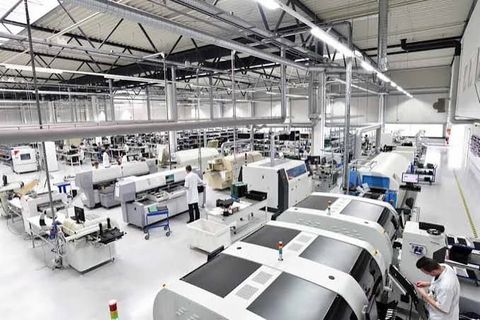
Automation helps maintain consistent production conditions and dimensional accuracy.
4. Electrical Testing
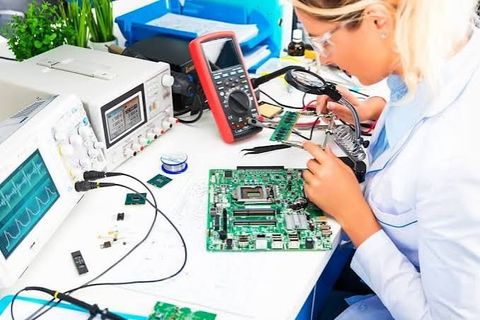
Components are tested against their specified electrical characteristics.
Depending on the component, testing may examine:
Resistance
Capacitance
Inductance
Voltage
Current
Leakage
Switching behavior
Frequency response
Thermal characteristics
Testing helps identify components that do not meet defined specifications.
5. Inspection
Visual and automated inspection systems can identify physical defects.
Modern production facilities may use machine vision and automated inspection equipment to examine:
Dimensions
Surface defects
Connections
Solder joints
Packaging
Markings
6. Packaging and Labelling
Finished components are packaged according to their size, application and handling requirements.
Packaging may include reels, trays, tubes, boxes or specialized protective packaging.
Labelling normally provides information such as component identification, batch information, manufacturing codes and other traceability details.
Semiconductor Component Manufacturing
Semiconductor manufacturing is one of the most technically advanced areas of electronic component production.
A simplified semiconductor manufacturing sequence includes:
Silicon wafer preparation
Wafer cleaning
Thin-film deposition
Photolithography
Etching
Doping or ion implantation
Interconnection formation
Wafer testing
Dicing
Packaging
Final testing
Modern semiconductor manufacturing requires highly controlled environments because extremely small particles or process variations can affect device performance.
Quality Control in Electronic Manufacturing
Quality control is important throughout the manufacturing lifecycle rather than only at the final inspection stage.
Common quality-control activities include:
Incoming material inspection
Process monitoring
Automated inspection
Electrical testing
Reliability testing
Environmental testing
Batch traceability
Final inspection
Statistical process control can also be used to identify process variation and maintain consistent manufacturing performance.
Testing and Reliability
Electronic components may be exposed to different environmental and electrical conditions during testing.
Depending on the component, reliability testing may evaluate:
Temperature variation
Humidity
Electrical stress
Mechanical stress
Vibration
Thermal cycling
Long-term operating conditions
The exact tests depend on the component category and its intended application.
Standards and Quality Frameworks
Electronic component manufacturers may work with different international standards and industry specifications.
Commonly referenced frameworks include:
| Standard / Framework | General Purpose |
|---|---|
| ISO 9001 | Quality management systems |
| ISO 14001 | Environmental management |
| IATF 16949 | Automotive quality management |
| IPC standards | Electronics manufacturing and assembly practices |
| IEC standards | International electrical and electronic standards |
| JEDEC standards | Semiconductor and electronic component specifications |
The applicable requirements depend on the component, industry and intended application.
Supply Chain and Component Traceability
Electronic component manufacturing depends on complex global supply chains.
Important stages can include:
Raw materials → Component manufacturing → Testing → Packaging → Distribution → Electronics assembly
Traceability allows manufacturers and downstream organizations to identify production batches and investigate quality issues.
Traceability can be particularly important for components used in automotive, industrial, aerospace and other applications with strict quality requirements.
Technologies Transforming Component Manufacturing
Electronic component manufacturing continues to evolve as electronic systems become smaller, faster and more energy efficient.
Miniaturization
Components are becoming smaller while maintaining or increasing functionality. This supports compact consumer electronics and increasingly dense circuit-board designs.
Advanced Semiconductor Manufacturing
Smaller semiconductor process technologies allow more computing and processing capability to be integrated into compact devices.
Silicon Carbide and Gallium Nitride
Wide-bandgap semiconductor materials such as silicon carbide and gallium nitride are increasingly important in applications involving power conversion and high-frequency operation.
Automated Manufacturing
Robotics, machine vision and automated testing can improve production consistency and help identify defects earlier.
Artificial Intelligence and Data Analytics
Manufacturing data can be analyzed to identify unusual process patterns, support predictive maintenance and improve production monitoring.
Internet of Things
Connected manufacturing equipment can collect operational data from production lines, supporting real-time monitoring and factory analytics.
Major Industries Using Electronic Components
Electronic components are used across many industries, including:
Consumer electronics
Automotive systems
Telecommunications
Industrial automation
Computers and data centers
Renewable-energy equipment
Medical electronics
Aerospace and defense systems
Smart-home technologies
IoT devices
Different industries may require different combinations of electrical performance, reliability, environmental resistance and regulatory compliance.
Key Challenges in Electronic Component Manufacturing
Manufacturers commonly need to manage several challenges:
Complex global supply chains
Rapid technology changes
Increasing miniaturization
Raw-material availability
Quality and reliability requirements
Counterfeit-component risks
Energy consumption
Production yield
Environmental considerations
Increasing automation complexity
Maintaining consistent quality while adapting to new technologies is an ongoing challenge across the industry.
Future Trends
Several developments are expected to continue influencing electronic component manufacturing:
Higher component integration
Smaller package sizes
Advanced semiconductor materials
AI-assisted manufacturing
Greater factory automation
More connected production equipment
Improved energy efficiency
Advanced sensors
High-speed communication components
Increasing demand for automotive electronics
The growth of artificial intelligence, electric mobility, connected devices and advanced computing is also increasing demand for specialized electronic components.
Frequently Asked Questions
What are the main types of electronic components?
The major categories are passive components, active components and electromechanical components. Resistors, capacitors, inductors, diodes, transistors, integrated circuits, connectors and switches are common examples.
How are electronic components tested?
Testing can include electrical measurements, visual inspection, automated inspection, thermal testing, environmental testing and reliability testing, depending on the component.
Why is traceability important?
Traceability helps identify the manufacturing batch, production history and relevant quality information associated with a component. It can support quality investigations and supply-chain management.
What technologies are changing component manufacturing?
Automation, machine vision, semiconductor process improvements, artificial intelligence, data analytics, connected manufacturing equipment and advanced materials are among the major developments.
Which industries use electronic components?
Almost every technology-dependent industry uses electronic components, including automotive, telecommunications, industrial automation, computing, consumer electronics, energy and medical electronics.
Conclusion
Electronic component manufacturing combines materials science, electrical engineering, precision production, automation and quality management. The manufacturing process can range from relatively simple component formation to highly complex semiconductor fabrication involving multiple precision-controlled stages.
As electronic systems continue to become smaller, more connected and more computationally capable, manufacturers are increasingly focusing on miniaturization, advanced materials, automation, reliability and data-driven production.
Understanding the components, manufacturing stages, testing methods and quality frameworks provides a useful foundation for learning how the modern electronics supply chain operates.
Disclaimer: This article is provided for general informational and educational purposes only. Manufacturing processes, standards, testing requirements and regulatory requirements can vary according to the component type, industry, country and intended application. Readers should refer to applicable standards, technical documentation and relevant authorities for specific requirements.

Related Post...
API Software Guide: Explore Types, Features, Integration, Security & Key Concepts
Updated: September 23, 2026
Read More
Electronic Testing Equipment Guide: Explore Laboratory Instruments, Functions & Measurements
Updated: September 24, 2026
Read More