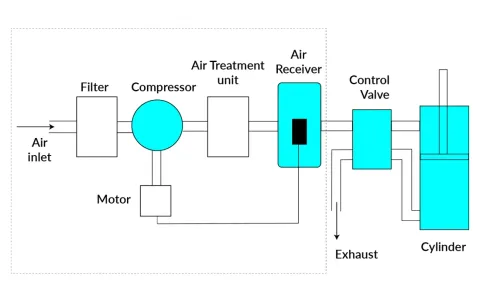
Pneumatic Power Systems: Fundamentals, Components & Practical Knowledge
Pneumatic power systems use compressed air to generate, control and transmit mechanical energy. They are widely used in manufacturing, automation, packaging, material handling and industrial equipment because they can provide controlled movement through relatively simple mechanical and electrical arrangements.
From operating a small air cylinder to controlling automated production machinery, pneumatic technology plays an important role in modern industrial environments.
Understanding these systems requires knowledge of air compression, pressure regulation, valves, actuators, air preparation and control mechanisms. Proper installation and maintenance are also important for reliable operation.
This guide explains the fundamentals of pneumatic power systems, their main components, practical applications, operating principles and safety considerations.
1. What Are Pneumatic Power Systems?
A pneumatic power system is a mechanical system that uses compressed air or another suitable gas to transmit and control energy.
Air is compressed using a compressor and delivered through pipes, hoses and control components to pneumatic devices. These devices convert the energy stored in compressed air into movement or mechanical force.
For example, an air cylinder can extend or retract a piston when compressed air enters its chamber.
Common applications include:
Operating industrial machinery.
Controlling automated production lines.
Moving materials and products.
Operating pneumatic tools.
Controlling packaging equipment.
Supporting assembly and manufacturing processes.
Operating doors, clamps and positioning mechanisms.
Pneumatic systems are particularly useful where repeated linear or rotational movement is required.
2. Fundamental Principles of Pneumatic Power
Pneumatic systems operate through the relationship between air pressure, volume, flow and force.
Understanding these principles helps explain how compressed air can operate different mechanical components.
Compressed Air
Atmospheric air is drawn into a compressor, where its pressure is increased. The compressed air is then stored or supplied directly to the distribution network.
Before reaching sensitive equipment, it may pass through filters, dryers and pressure regulators.
Pressure and Force
Pressure is the force applied over a specific area. In a pneumatic cylinder, air pressure acts on the piston surface and produces a mechanical force.
The basic relationship is:
Force = Pressure × Area
Where:
Force is measured in newtons (N).
Pressure is measured in pascals (Pa).
Area is measured in square metres (m²).
For example, a piston with an effective area of 0.01 m² operating at a pressure of 500,000 Pa produces an ideal theoretical force of:
500,000 × 0.01 = 5,000 N
Actual output force may be lower because of friction, pressure losses and mechanical resistance.
Air Flow
Airflow refers to the movement of compressed air through pipes, valves and other components.
Flow rate influences how quickly a pneumatic actuator operates. Pipe diameter, valve capacity, operating pressure and system restrictions can all affect airflow.
Boyle's Law
Boyle's Law describes the relationship between the pressure and volume of a fixed quantity of gas when temperature remains constant.
It helps explain the behaviour of compressed gases, although practical pneumatic systems also involve temperature changes and continuous airflow.
3. Main Components of a Pneumatic Power System
A pneumatic system contains several components that work together to generate, prepare, control and use compressed air.
Air Compressor
The compressor is responsible for increasing the pressure of atmospheric air.
Common compressor types include:
Reciprocating compressors: Use a piston mechanism to compress air.
Rotary screw compressors: Use rotating screw elements to compress air continuously.
Centrifugal compressors: Use high-speed rotating impellers to increase air pressure.
The appropriate compressor depends on the required pressure, airflow, operating duration and application.
Air Receiver Tank
An air receiver stores compressed air and helps balance variations between air supply and demand.
It can also reduce pressure fluctuations and provide a reserve of compressed air for short periods of higher demand.
Receiver tanks must be designed, installed, inspected and maintained according to applicable pressure-vessel requirements.
Air Filters
Filters remove particles and other contaminants from compressed air.
Contamination can affect valves, seals, cylinders and other pneumatic components. Appropriate filtration helps protect equipment and maintain consistent operation.
Air Dryers
Compressed air may contain moisture that can condense as the air cools.
Air dryers reduce moisture content and help prevent corrosion, freezing and operational problems in downstream equipment.
Common types include refrigerated dryers and desiccant dryers.
Pressure Regulators
Pressure regulators maintain a controlled downstream pressure within the specified operating range.
They help ensure that connected equipment receives suitable air pressure rather than being exposed to unnecessary pressure variations.
Lubricators
Some pneumatic equipment requires lubrication to reduce friction and wear.
A lubricator introduces a controlled amount of lubricant into the compressed-air stream where the equipment manufacturer specifies its use. Many modern components are designed for operation without additional air-line lubrication.
Pneumatic Pipes and Hoses
Pipes and hoses transport compressed air from the supply system to valves and actuators.
They must be suitable for the operating pressure, temperature, environment and connection requirements.
Pneumatic Actuators
Actuators convert compressed-air energy into mechanical movement.
Common examples include:
Pneumatic cylinders.
Rotary actuators.
Air motors.
Grippers.
Diaphragm actuators.
The type of actuator depends on the movement and force required.
4. Types of Pneumatic Cylinders
Pneumatic cylinders are among the most common actuators used in industrial systems. They convert compressed air into linear mechanical movement.
Single-Acting Cylinders
A single-acting cylinder uses compressed air to move its piston in one direction. A spring or external force generally returns the piston to its original position.
Typical applications include simple clamping, positioning and pressing operations.
Double-Acting Cylinders
A double-acting cylinder uses compressed air to move the piston in both directions.
Air is supplied alternately to either side of the piston, allowing controlled extension and retraction.
These cylinders are commonly used in automated machinery, material handling and assembly systems.
Rodless Cylinders
Rodless cylinders move a carriage along the cylinder body without using a conventional external piston rod.
They can be useful in applications where installation space is limited or where a longer stroke is required.
Rotary Actuators
Rotary actuators convert compressed air into rotational movement.
They are commonly used for turning, indexing, positioning and operating certain mechanical assemblies.
5. Pneumatic Control Valves
Control valves regulate the direction, pressure and flow of compressed air within a pneumatic circuit.
Their operation determines how and when an actuator moves.
Directional Control Valves
Directional control valves determine the path through which compressed air travels.
They are often described by the number of ports and switching positions.
Examples include:
2/2-way valves: Have two ports and two switching positions.
3/2-way valves: Have three ports and two switching positions.
5/2-way valves: Have five ports and two switching positions.
5/3-way valves: Have five ports and three switching positions.
A 3/2-way valve is commonly used with single-acting cylinders, while a 5/2-way valve is frequently used with double-acting cylinders.
Flow Control Valves
Flow control valves regulate the amount of compressed air passing through a circuit.
They can be used to adjust actuator speed by controlling airflow into or out of a cylinder.
Pressure Control Valves
Pressure control valves help regulate or limit system pressure.
Examples include pressure regulators, relief valves and pressure sequence valves, each serving a different control purpose.
Solenoid Valves
Solenoid valves use an electrical signal to operate a valve mechanism.
They are widely used in automated systems because they allow pneumatic circuits to be controlled through electrical controllers, sensors and programmable logic controllers.
6. How a Pneumatic Power System Works
A typical pneumatic system follows a sequence from air generation to mechanical movement.
Air intake: Atmospheric air enters the compressor through an intake arrangement.
Compression: The compressor increases the air pressure.
Storage: Compressed air may be stored in an air receiver.
Air preparation: Filters, dryers and regulators prepare the air for connected equipment.
Distribution: Pipes and hoses carry the compressed air to the control circuit.
Direction control: Valves determine where the compressed air flows.
Actuation: The compressed air operates a cylinder, motor or another actuator.
Exhaust: Used air is released through designated exhaust ports or components.
This arrangement can be expanded with sensors, controllers and additional valves to support more complex automated operations.
7. Practical Applications of Pneumatic Systems
Pneumatic technology is used in several industries because it can support repetitive movement, equipment control and automation.
Manufacturing and Assembly
Pneumatic cylinders and grippers are used for positioning, clamping, lifting and moving components during manufacturing operations.
Packaging Industry
Packaging machinery uses pneumatic actuators to operate cutting mechanisms, sealing equipment, product pushers and sorting systems.
Automotive Manufacturing
Pneumatic equipment can support assembly operations, component handling, fastening tools and automated production processes.
Food and Beverage Processing
Pneumatic systems may operate conveyors, packaging equipment and selected handling mechanisms. Applications requiring contact with food or sensitive production environments need appropriate equipment materials and air-quality controls.
Material Handling
Pneumatic cylinders and vacuum systems can support lifting, gripping, sorting and positioning tasks.
Pharmaceutical Manufacturing
Pneumatic automation may be used in packaging, material movement and selected production processes. Air cleanliness and contamination-control requirements depend on the application.
8. Pneumatic Systems Compared with Hydraulic Systems
Pneumatic and hydraulic systems both use pressurised fluids to transmit power, but they have different operating characteristics.
| Feature | Pneumatic Systems | Hydraulic Systems |
|---|---|---|
| Working medium | Compressed air or gas | Hydraulic fluid |
| Compressibility | Air is compressible | Liquids are nearly incompressible |
| Typical applications | Automation and light-to-moderate force operations | High-force machinery and heavy equipment |
| Movement control | Often suitable for rapid repetitive movement | Can provide precise control under suitable conditions |
| Leakage concerns | Air leakage and pressure loss | Fluid leakage and contamination |
| Maintenance | Air quality, leaks and component condition | Fluid quality, filters, seals and pressure |
| Environmental considerations | Exhaust noise and energy consumption | Fluid spills and fluid disposal |
The choice between pneumatic and hydraulic technology depends on force requirements, control accuracy, operating environment, energy use and equipment design.
9. Maintenance of Pneumatic Power Systems
Regular maintenance helps maintain reliable operation and identify potential problems before they interrupt production.
Inspect Air Filters
Check filter elements for contamination and follow manufacturer guidance for cleaning or replacement.
Monitor Air Pressure
Verify that pressure regulators and gauges operate within the specified ranges.
Incorrect pressure can affect actuator movement and equipment performance.
Check for Air Leaks
Leaks can increase compressor demand and reduce the pressure available to connected equipment.
Inspect hoses, fittings, connectors, valves and seals for leakage.
Drain Moisture
Condensate may collect in air receivers, filters and other system components.
Drainage and moisture management should follow the equipment manufacturer's instructions and applicable safety procedures.
Inspect Hoses and Connections
Look for cracks, abrasion, loose fittings and other visible damage.
Replace unsuitable or damaged components with parts rated for the system's operating conditions.
Check Valves and Actuators
Monitor cylinders, valves and actuators for unusual noise, inconsistent movement, sticking or visible damage.
Review System Performance
Record pressure, airflow, leakage, maintenance activities and repeated faults. These records can help identify patterns and support maintenance planning.
10. Common Pneumatic System Problems
Pneumatic equipment can experience several operating issues.
Low Air Pressure
Possible causes include compressor problems, excessive demand, restricted filters, undersized distribution lines or air leakage.
Slow Cylinder Movement
This may result from insufficient airflow, incorrect flow-control settings, excessive mechanical load or damaged components.
Air Leakage
Leakage can occur through worn seals, damaged hoses, loose connections or faulty valves.
Moisture in Air Lines
Insufficient drying or poor condensate management can allow moisture to enter downstream equipment.
Irregular Actuator Movement
Contamination, pressure fluctuations, mechanical friction and valve problems may contribute to inconsistent movement.
Excessive Noise
Compressed-air exhaust and equipment operation can create noise. Suitable silencers, correct pressure settings and equipment maintenance can help manage noise levels.
Troubleshooting should be performed by trained personnel using the equipment documentation and approved procedures.
11. Safety Considerations in Pneumatic Systems
Compressed air stores energy and can create serious hazards if a system is incorrectly designed, operated or maintained.
Important safety practices include:
Use components rated for the intended operating pressure.
Never exceed the manufacturer's pressure limits.
Secure hoses and connections properly.
Isolate the compressed-air supply before maintenance.
Release trapped pressure using approved procedures.
Prevent unexpected machine start-up.
Use suitable protective guards around moving actuators.
Avoid directing compressed air towards people.
Use appropriate eye and hearing protection where required.
Inspect pressure vessels and safety devices according to applicable requirements.
Pneumatic actuators may move unexpectedly if residual pressure remains in the system. Maintenance procedures should therefore account for stored pneumatic energy, isolation and controlled depressurisation.
ISO 4414:2010 provides general rules and safety requirements for pneumatic fluid power systems and components used on machinery. ISO lists this edition as reviewed and confirmed in 2021. 1
OSHA also provides technical guidance on compressed-air systems, including pneumatic equipment and noise considerations. 2
12. Frequently Asked Questions
1. What is the main purpose of a pneumatic power system?
A pneumatic power system uses compressed air to transmit and control energy. It operates components such as cylinders, motors, valves and grippers to produce mechanical movement.
2. What are the main components of a pneumatic system?
Common components include an air compressor, receiver tank, filters, dryers, pressure regulators, pipes, hoses, control valves and pneumatic actuators.
3. What is the difference between a single-acting and double-acting cylinder?
A single-acting cylinder uses compressed air for movement in one direction and generally uses a spring or external force for its return. A double-acting cylinder uses compressed air to move in both directions.
4. Why is air filtration important in pneumatic systems?
Filtration removes particles and contaminants that may affect valves, seals, cylinders and other equipment. Appropriate air preparation helps protect components and support reliable operation.
5. Where are pneumatic systems commonly used?
They are used in manufacturing, packaging, automotive assembly, material handling, food processing, pharmaceutical production and industrial automation.
Conclusion
Pneumatic power systems are an important part of industrial automation and mechanical equipment. By using compressed air to generate and control movement, they support a wide range of operations, from simple cylinder applications to complex automated production processes.
Understanding compressors, air preparation equipment, control valves, actuators and distribution networks provides a foundation for working with pneumatic technology. Proper component selection, maintenance and safety procedures are equally important for dependable operation.
As industrial automation continues to develop, pneumatic systems remain a relevant technology for applications requiring controlled movement, repeatable operations and integration with automated machinery.
Disclaimer: This article is intended for general educational and informational purposes. Pneumatic system design, installation, maintenance and operation should be performed by qualified personnel in accordance with equipment documentation, applicable safety standards and local regulations.

Related Post...

PLC Control Systems: Fundamentals, Architecture, Programming & Applications
Updated: November 12, 2026
Read More
Tyre Building Machine Buying Guide: Explore Machine Types, Features & Expert Insights
Updated: July 29, 2026
Read More