AI Frameworks Explained: Explore How They Work, Types, Tools & Applications
Artificial intelligence development involves more than creating algorithms and training models. Developers also need software tools that help them build, train, evaluate, deploy and maintain AI systems.
AI frameworks provide structured libraries, programming interfaces and development components that simplify many of these tasks. They can support areas such as machine learning, deep learning, natural language processing, computer vision, generative AI and model deployment.
Instead of implementing every mathematical operation or training procedure from scratch, developers can use established frameworks to work with tensors, neural networks, datasets, optimization methods and hardware acceleration.
This guide explains what AI frameworks are, how they work, the major types, commonly used tools, development workflows and practical applications.
What Is an AI Framework?
An AI framework is a software framework or library that provides reusable components for developing artificial intelligence and machine-learning systems.
Depending on its design, an AI framework may provide:
- Mathematical operations
- Neural-network components
- Model-building APIs
- Training utilities
- Optimization algorithms
- Data-processing tools
- Hardware acceleration
- Model evaluation functions
- Deployment capabilities
- Visualization or debugging tools
Frameworks allow developers to focus more on model architecture and application requirements instead of implementing fundamental computational operations themselves.
How Do AI Frameworks Work?
An AI framework typically sits between an AI application and lower-level computing resources.
A simplified workflow looks like this:
Data
  ↓
Data Processing
  ↓
AI Framework
  ↓
Model Architecture
  ↓
Training / Inference
  ↓
Hardware Acceleration
  ↓
Model Output
  ↓
Application
The framework provides the software abstractions needed to manage these stages.
Main Components of an AI Framework
Different frameworks have different architectures, but several components are common.
Mathematical Operations
AI models require operations involving:
- Matrices
- Vectors
- Tensors
- Multiplication
- Addition
- Activation functions
- Probability calculations
Frameworks provide optimized implementations of these operations.
Model Architecture
Frameworks can provide reusable components for constructing models.
Examples include:
- Dense layers
- Convolutional layers
- Recurrent layers
- Attention mechanisms
- Embedding layers
- Normalization layers
Training System
Training systems manage processes such as:
- Forward propagation
- Loss calculation
- Backpropagation
- Gradient calculation
- Parameter updates
Optimization
Optimization algorithms help adjust model parameters during training.
Common examples include:
- Stochastic Gradient Descent
- Adam
- AdamW
- RMSProp
Hardware Acceleration
Many frameworks can use hardware accelerators to improve computational performance.
Depending on the environment, this can include:
- CPUs
- GPUs
- Specialized AI accelerators
AI Frameworks and Machine Learning
Machine learning is one of the primary areas supported by AI frameworks.
Machine-learning systems learn patterns from data rather than relying entirely on explicitly programmed rules.
Frameworks can help developers implement:
- Classification
- Regression
- Clustering
- Dimensionality reduction
- Feature processing
- Model evaluation
AI Frameworks and Deep Learning
Deep-learning frameworks focus heavily on neural networks with multiple computational layers.
They can support architectures such as:
- Convolutional neural networks
- Recurrent neural networks
- Transformers
- Autoencoders
- Generative models
Deep-learning frameworks also commonly provide automatic differentiation and GPU acceleration.
Types of AI Frameworks
AI frameworks can be categorized according to their primary purpose.
Machine Learning Frameworks
These frameworks provide algorithms and utilities for conventional machine learning.
They can support:
- Classification
- Regression
- Clustering
- Preprocessing
- Model selection
- Evaluation
Deep Learning Frameworks
These frameworks focus on neural-network development and training.
They typically provide:
- Tensor operations
- Neural-network layers
- Automatic differentiation
- Optimizers
- Hardware acceleration
Natural Language Processing Frameworks
NLP frameworks help developers work with human language.
Potential applications include:
- Text classification
- Translation
- Summarization
- Question answering
- Information extraction
- Text generation
Computer Vision Frameworks
Computer-vision frameworks support applications involving images and video.
They can be used for:
- Image classification
- Object detection
- Image segmentation
- Image generation
- Facial analysis
- Visual feature extraction
Generative AI Frameworks
Generative AI frameworks and libraries support applications involving models that generate:
- Text
- Images
- Audio
- Video
- Code
These tools often provide access to pretrained models and components for adapting them to specific applications.
Deployment Frameworks
Deployment-focused tools help move trained models into production environments.
They can support:
- Model serving
- API integration
- Hardware optimization
- Edge deployment
- Batch inference
- Real-time inference
Popular AI Frameworks and Libraries
The AI ecosystem contains numerous frameworks and libraries.
TensorFlow
TensorFlow is an open-source machine-learning platform associated with Google.
It provides tools for:
- Model development
- Training
- Deployment
- Numerical computation
- Production workflows
TensorFlow supports multiple development environments and hardware configurations.
PyTorch
PyTorch is an open-source machine-learning framework widely used for research and application development.
It provides capabilities for:
- Tensor computation
- Automatic differentiation
- Neural-network development
- Model training
- GPU acceleration
Its Python-oriented development experience has contributed to broad adoption among AI developers and researchers.
Scikit-learn
Scikit-learn is a Python machine-learning library focused primarily on traditional machine-learning techniques.
It includes implementations for:
- Classification
- Regression
- Clustering
- Dimensionality reduction
- Model selection
- Preprocessing
It is commonly used for structured-data machine-learning workflows.
Keras
Keras provides a high-level API for developing machine-learning models.
It is designed to make model development more accessible while supporting increasingly sophisticated neural-network architectures.
Keras can work with supported backend systems depending on the configuration.
Hugging Face Transformers
The Transformers ecosystem from Hugging Face provides access to a large collection of pretrained models and tools for tasks involving language, vision, audio and multimodal applications.
It is particularly relevant to modern transformer-based AI development.
JAX
JAX is a numerical-computing framework designed around transformations such as automatic differentiation and compilation.
It is used for high-performance numerical and machine-learning workloads.
AI Framework vs AI Library
The terms framework and library are sometimes used interchangeably, but there is a conceptual distinction.
A library generally provides reusable functions that an application calls.
A framework can provide a broader development structure and may influence how an application or model is organized.
In practice, AI software ecosystems frequently contain both frameworks and libraries, making the terminology somewhat flexible.
AI Framework vs AI Model
An AI framework is the software environment or toolkit used to build, train or run AI models.
An AI model is the trained computational system that produces predictions, classifications, generated content or other outputs.
For example:
AI Framework
     ↓
Model Architecture
     ↓
Training Data
     ↓
Training Process
     ↓
Trained AI Model
     ↓
Application
The framework provides the tools; the model represents the learned system.
AI Framework vs AI Platform
An AI framework generally focuses on software development capabilities.
An AI platform can provide a broader collection of infrastructure and services, potentially including:
- Data management
- Model development
- Training infrastructure
- Model deployment
- Monitoring
- Security
- Governance
The distinction varies across vendors and technical environments.
AI Development Workflow
A typical AI development process can involve several stages.
Step 1: Define the Problem
The development team first identifies the objective.
Examples include:
- Predicting a value
- Classifying documents
- Recognizing objects
- Generating text
- Detecting anomalies
Step 2: Collect Data
Relevant data is gathered from appropriate sources.
Step 3: Prepare the Data
Data may require:
- Cleaning
- Normalization
- Transformation
- Labeling
- Feature engineering
- Splitting
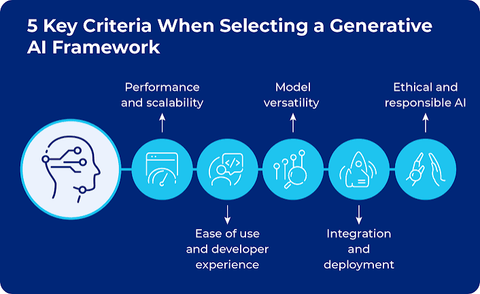
Step 4: Select a Framework
The framework can be selected based on:
- Model type
- Programming language
- Hardware
- Ecosystem
- Deployment requirements
- Developer experience
Step 5: Build the Model
Developers define the model architecture or use a pretrained model.
Step 6: Train the Model
The model learns patterns from the training dataset.
Step 7: Evaluate Performance
The model is evaluated using appropriate metrics and datasets.
Step 8: Optimize
Developers may adjust:
- Model architecture
- Hyperparameters
- Data
- Training strategy
- Hardware configuration
Step 9: Deploy
The trained model is integrated into an application or production environment.
Step 10: Monitor
Production models can be monitored for performance, errors, data changes and operational issues.
AI Frameworks and GPUs
AI model training can involve large numbers of mathematical operations.
GPUs can accelerate many of these workloads through parallel computation.
Frameworks can provide mechanisms for moving data and computations between:
- CPU
- GPU
- Other supported accelerators
Hardware compatibility should be checked for the specific framework and version being used.
AI Frameworks and Cloud Computing
Cloud platforms can provide infrastructure for AI development and deployment.
Cloud-based environments can offer:
- Computing resources
- GPU instances
- Data storage
- Model deployment
- Development environments
- Monitoring tools
AI frameworks can operate within these environments while providing the model-development layer.
AI Frameworks for Natural Language Processing
AI frameworks and libraries can support many NLP workflows.
Applications include:
- Text classification
- Sentiment analysis
- Translation
- Summarization
- Search
- Question answering
- Chatbots
- Document analysis
Transformer architectures have become particularly important for modern language applications.
AI Frameworks for Computer Vision
Computer-vision development can use frameworks to process images and video.
Common tasks include:
- Image classification
- Object detection
- Semantic segmentation
- Instance segmentation
- Image enhancement
- Visual inspection
Frameworks can provide pretrained architectures and optimized computational operations.
AI Frameworks for Generative AI
Generative AI development commonly combines several software components.
A typical architecture may include:
Application
    ↓
AI Framework / Library
    ↓
Pretrained Model
    ↓
Inference Engine
    ↓
Hardware
Additional components can include:
- Tokenizers
- Embedding models
- Vector databases
- Retrieval systems
- Prompt-processing components
- Model-serving systems
AI Frameworks and Large Language Models
Large language models, or LLMs, require significant computational infrastructure.
Frameworks and associated libraries can support:
- Tokenization
- Model loading
- Fine-tuning
- Inference
- Quantization
- Distributed processing
- Evaluation
Developers may also use specialized inference and optimization tools alongside the primary framework.
AI Frameworks and RAG Applications
Retrieval-Augmented Generation, commonly known as RAG, combines information retrieval with generative AI.
A simplified workflow is:
User Query
    ↓
Embedding / Retrieval
    ↓
Relevant Information
    ↓
Language Model
    ↓
Generated Response
AI frameworks can provide model-processing capabilities while separate tools may manage document ingestion, embeddings, vector search and retrieval.
AI Frameworks for Edge AI
Edge AI involves running AI models closer to where data is generated.
Examples include:
- Smartphones
- Cameras
- Industrial devices
- Vehicles
- IoT devices
- Embedded systems
Edge deployment often requires attention to:
- Model size
- Memory
- Processing power
- Latency
- Energy consumption
Frameworks and optimization tools can help adapt models to these constraints.
AI Frameworks in Robotics
Robotics applications can combine AI frameworks with sensors, control systems and robotics middleware.
Potential applications include:
- Object recognition
- Navigation
- Motion planning
- Visual perception
- Autonomous operation
- Human-robot interaction
AI is typically only one component of a complete robotic system.
AI Frameworks in Healthcare Technology
AI frameworks can support research and software development involving:
- Medical image analysis
- Signal processing
- Data classification
- Predictive modeling
- Research-oriented clinical datasets
Healthcare AI applications require particular attention to validation, privacy, security and applicable regulatory requirements.
AI Frameworks in Finance
AI and machine-learning frameworks can support analytical applications involving:
- Fraud detection
- Risk analysis
- Customer segmentation
- Forecasting
- Document processing
- Anomaly detection
Actual implementation depends on data quality, regulatory requirements and the intended use case.
AI Frameworks in Manufacturing
Manufacturing applications can include:
- Predictive maintenance
- Visual quality inspection
- Process monitoring
- Demand forecasting
- Robotics
- Anomaly detection
AI frameworks can provide the computational foundation for these models.
AI Frameworks in Retail
Retail applications can include:
- Demand forecasting
- Recommendation systems
- Inventory analysis
- Customer segmentation
- Image recognition
- Text analytics
The appropriate framework depends on the type of data and model being developed.
AI Frameworks in Automotive Technology
Automotive AI applications can involve:
- Computer vision
- Driver-assistance systems
- Object detection
- Sensor processing
- Predictive maintenance
- Vehicle personalization
AI frameworks may be combined with specialized automotive computing platforms and deployment tools.
Benefits of AI Frameworks
Faster Development
Reusable components reduce the amount of low-level code developers need to create.
Access to Optimized Operations
Many frameworks provide optimized mathematical operations.
Hardware Support
Frameworks can support CPUs, GPUs and other accelerators.
Pretrained Models
Modern ecosystems provide access to pretrained models that can reduce development effort.
Large Developer Communities
Popular frameworks often have extensive documentation and community resources.
Deployment Options
Some ecosystems provide tools for moving models from development into production.
Limitations of AI Frameworks
AI frameworks also have limitations.
Learning Curve
Complex frameworks can require substantial technical knowledge.
Hardware Requirements
Large models may require significant computational resources.
Version Compatibility
Libraries, frameworks, drivers and hardware software can have compatibility requirements.
Performance Differences
Different frameworks may perform differently depending on the model and hardware.
Maintenance
AI software ecosystems evolve rapidly, requiring developers to maintain dependencies and update systems.
Choosing an AI Framework
There is no single framework that is ideal for every project.
Consider the following factors:
Project Requirements
Identify the type of AI workload.
Programming Language
Python is widely used across AI development, although other languages can also be supported.
Model Type
A computer-vision model may require different tools from a traditional tabular-data model.
Hardware
Consider CPU, GPU and accelerator compatibility.
Ecosystem
A strong ecosystem can provide libraries, pretrained models, documentation and community support.
Deployment
Consider whether the model will run:
- On a server
- In the cloud
- On an edge device
- In a browser
- On a mobile device
Community and Documentation
Clear documentation can reduce development and troubleshooting time.
Long-Term Maintenance
Consider release cycles, dependency management and compatibility requirements.
AI Framework Comparison
| Framework / Library | Primary Focus | Common Language | Typical Applications |
|---|---|---|---|
| TensorFlow | Machine learning and deep learning | Python and others | Training, deployment, production AI |
| PyTorch | Machine learning and deep learning | Python and others | Research, training, AI applications |
| Scikit-learn | Traditional machine learning | Python | Classification, regression, clustering |
| Keras | High-level neural-network development | Python | Deep-learning model development |
| JAX | Numerical computing and ML | Python | High-performance numerical workloads |
| Transformers | Pretrained AI models | Python | NLP, vision, audio and multimodal AI |
The capabilities of each ecosystem can change as versions and supporting projects evolve.
AI Framework Development Tools
AI development commonly involves more than a single framework.
A broader toolkit can include:
- Python
- Jupyter environments
- Version-control systems
- Data-processing libraries
- Visualization libraries
- Model registries
- Experiment tracking tools
- Container technologies
- Cloud infrastructure
- Model-serving systems
The exact combination depends on the project.
AI Frameworks and MLOps
MLOps combines machine learning development with software engineering and operational practices.
An MLOps workflow can include:
Data
 ↓
Training
 ↓
Evaluation
 ↓
Model Registry
 ↓
Deployment
 ↓
Monitoring
 ↓
Retraining
AI frameworks generally handle the model-development portion, while additional tools manage deployment, monitoring and lifecycle operations.
AI Framework Security Considerations
Security should be considered throughout AI development.
Important areas include:
- Dependency management
- Model integrity
- Data protection
- Access control
- API security
- Infrastructure security
- Secure model deployment
- Supply-chain security
Frameworks should be maintained according to appropriate software-security practices.
AI Frameworks and Data Privacy
AI systems frequently process large datasets, some of which may contain sensitive information.
Development teams should consider:
- Data minimization
- Access controls
- Encryption
- Data retention
- Anonymization where appropriate
- Regulatory requirements
- Secure storage
Privacy requirements depend on the application and jurisdiction.
Future of AI Frameworks
AI frameworks are continuing to evolve alongside advances in artificial intelligence.
Important trends include:
Multimodal AI
Frameworks increasingly support models capable of working with combinations of text, images, audio and other data types.
Generative AI
Large generative models are creating new requirements around inference, fine-tuning and deployment.
Efficient Inference
Optimization techniques are becoming increasingly important for reducing latency and computational requirements.
Edge AI
More AI workloads are moving toward local devices and specialized hardware.
Automated Development
Higher-level tools are making some aspects of model development more accessible.
Specialized Hardware
Framework ecosystems are adapting to increasingly diverse AI accelerators.
Frequently Asked Questions
What is an AI framework?
An AI framework is a software toolkit that provides reusable components for developing, training, evaluating or deploying artificial-intelligence and machine-learning models.
What are some popular AI frameworks?
Popular AI development ecosystems include TensorFlow, PyTorch, Scikit-learn, Keras and JAX. Hugging Face Transformers is also widely used for pretrained AI models.
What is the difference between an AI framework and an AI model?
A framework provides software tools used to develop or run AI systems, while a model is the trained computational system that produces outputs.
Are AI frameworks used for machine learning?
Yes. AI frameworks can support traditional machine learning, deep learning and specialized AI workloads.
Which AI framework is best?
There is no universally best framework. The appropriate choice depends on the model type, programming language, hardware, ecosystem, deployment requirements and development team's needs.
Are AI frameworks used for generative AI?
Yes. Frameworks and related libraries can support generative AI model development, fine-tuning, inference and deployment.
Can AI frameworks use GPUs?
Many AI frameworks support GPU acceleration, although the exact hardware and software requirements vary.
Are AI frameworks free to use?
Many popular AI frameworks are available as open-source software. However, infrastructure, cloud computing, specialized hardware and other development resources can involve separate expenses.
What programming language is commonly used with AI frameworks?
Python is one of the most widely used languages for AI and machine-learning development. Some frameworks also support other programming languages.
What are AI frameworks used for?
They can be used for applications involving machine learning, deep learning, natural language processing, computer vision, generative AI, robotics, forecasting and many other computational tasks.
Conclusion
AI frameworks provide the software foundation for building many modern artificial-intelligence systems. They offer reusable components for mathematical computation, neural-network development, model training, optimization, hardware acceleration and deployment.
Frameworks such as TensorFlow, PyTorch, Scikit-learn, Keras and JAX, along with specialized ecosystems such as Hugging Face Transformers, support different areas of AI development.
The right framework depends on the project's requirements. Developers can consider model type, programming language, hardware, ecosystem, pretrained-model availability, deployment environment, documentation and long-term maintenance when evaluating their options.
As AI continues to expand into generative AI, multimodal systems, edge computing, robotics and enterprise applications, AI frameworks are likely to remain an important part of the development ecosystem.
Disclaimer: This article is provided for general informational and educational purposes only. AI frameworks, software versions, hardware compatibility and available features can change over time. Developers should consult current official documentation and licensing information before selecting or deploying a framework for a specific project.

Lavit
Our content is designed to attract, persuade, and convert your audience. We help brands grow through strategic, audience-first writing.
September 07, 2026 . 8 min read
Related Post...

Client Management Software Guide: Explore CRM Features, Automation & Expert Insight
By: Lavit
Updated: September 13, 2026
Read More
Complete AI Framework Guide: Explore Development, Architecture, Libraries & Applications
By: Lavit
Updated: September 07, 2026
Read More
Client Management System Explained: Explore CRM, Client Data, Interactions & Workflow Management
By: Lavit
Updated: September 14, 2026
Read More