CNC Milling Machines: A Beginner’s Guide to Basics, Operation, and Essential Knowledge
CNC milling machines are computer-controlled tools used to shape solid materials such as metal, plastic, and composites. The term CNC stands for Computer Numerical Control, meaning the machine follows programmed instructions rather than manual operation.
The idea behind CNC milling developed from the need for higher precision, repeatability, and efficiency in manufacturing. Traditional manual milling relied heavily on operator skill, which limited accuracy and consistency. CNC technology was introduced to solve these limitations by automating tool movement using digital designs.
Today, CNC milling machines are widely used in industries where accuracy and reliability are essential. They exist to transform digital design files into physical components with tight tolerances and complex geometries that would be difficult to achieve manually.
Importance: Why CNC Milling Machines Matter Today
CNC milling machines play a critical role in modern manufacturing and industrial automation. They affect a wide range of sectors, from small workshops to large-scale production facilities.
Key reasons CNC milling is important include:
-
High precision and dimensional accuracy
-
Consistent output across repeated operations
-
Reduced human error
-
Ability to produce complex shapes and fine details
Industries that rely on CNC milling include:
-
Aerospace and aviation
-
Automotive manufacturing
-
Medical device production
-
Electronics and semiconductor industries
-
Industrial machinery and tooling
CNC milling solves problems related to inefficiency, inconsistency, and scalability. By automating cutting processes, organizations can maintain quality standards while meeting increasing production demands.
Recent Updates: Trends and Developments in CNC Milling
Over the past year, CNC milling technology has continued to evolve alongside broader manufacturing trends.
Notable developments during 2024 and early 2025 include:
-
Increased integration of artificial intelligence for toolpath optimization
-
Wider adoption of multi-axis CNC milling systems
-
Growth in digital twin simulations for process validation
-
Improved compatibility with advanced CAD/CAM software
In mid-2024, manufacturers began focusing more on energy-efficient spindle motors and smart monitoring systems. These improvements aim to reduce machine downtime and enhance predictive maintenance.
Another key trend has been the growing use of Industry 4.0 concepts, where CNC milling machines are connected to centralized data platforms for performance analysis and production planning.
Laws or Policies: Regulatory Influence on CNC Milling
CNC milling machines are subject to industrial safety, environmental, and manufacturing regulations that vary by country.
In many regions, regulations focus on:
-
Machine safety standards for operators
-
Electrical and mechanical compliance
-
Noise and emission control
-
Workplace safety training requirements
For example, industrial equipment regulations often require emergency stop mechanisms, protective enclosures, and proper documentation. Environmental policies may also influence coolant disposal and material waste handling.
Government-supported manufacturing modernization programs in several countries encourage the adoption of automated machining systems, including CNC milling, to improve industrial competitiveness and production quality.
Tools and Resources: Helpful CNC Milling Aids
Several tools and digital resources support learning, planning, and operating CNC milling machines effectively.
Commonly used tools and resources include:
-
CAD software for creating digital designs
-
CAM software for generating toolpaths
-
CNC simulators for virtual machining practice
-
G-code reference libraries
-
Online machining calculators for feeds and speeds
Popular Resource Categories
| Resource Type | Purpose |
|---|---|
| CAD Platforms | Design 2D and 3D components |
| CAM Systems | Convert designs into machine instructions |
| CNC Simulators | Visualize machining processes |
| Material Databases | Reference cutting parameters |
| Technical Forums | Knowledge sharing and troubleshooting |
These resources help beginners understand machine behavior and improve operational accuracy without unnecessary trial and error.
CNC Milling Machine Basics Explained
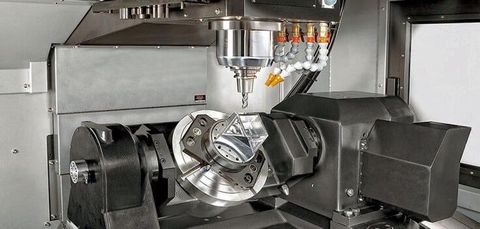
A CNC milling machine removes material using rotating cutting tools. The workpiece is fixed on a table, while the cutting tool moves along programmed paths.
Core components include:
-
Spindle for tool rotation
-
Machine table for workpiece positioning
-
Control panel or CNC controller
-
Linear axes (X, Y, and Z)
-
Tool holders and cutting tools
Basic Axis Configuration
| Axis | Movement Direction |
|---|---|
| X-axis | Left to right |
| Y-axis | Front to back |
| Z-axis | Up and down |
Advanced machines may include additional rotational axes to allow complex machining from multiple angles.
How CNC Milling Machines Operate
The operation of a CNC milling machine follows a structured workflow.
Typical steps include:
-
Creating a digital design using CAD software
-
Generating toolpaths with CAM software
-
Loading the program into the CNC controller
-
Setting up tools and workpiece
-
Running the machining process
The machine reads coded instructions that control speed, direction, depth of cut, and tool movement. This automation ensures consistent results across multiple runs.
FAQs About CNC Milling Machines
What materials can CNC milling machines work with?
CNC milling machines commonly process metals, plastics, composites, and certain wood materials, depending on machine capability and tooling.
Is CNC milling suitable for beginners?
Yes. With proper training and simulation tools, beginners can learn CNC milling fundamentals safely and effectively.
What is the difference between CNC milling and CNC turning?
CNC milling uses rotating tools to cut stationary material, while CNC turning rotates the workpiece against a stationary cutting tool.
How accurate are CNC milling machines?
Modern CNC milling machines can achieve very tight tolerances, often within microns, depending on machine quality and setup.
What skills are needed to operate CNC milling machines?
Basic skills include understanding technical drawings, machine setup, tool selection, and interpreting CNC programs.
CNC Milling Technology Comparison
| Feature | Manual Milling | CNC Milling |
|---|---|---|
| Precision | Operator-dependent | High and consistent |
| Repeatability | Limited | Excellent |
| Complexity | Simple shapes | Complex geometries |
| Automation | Minimal | Fully automated |
This comparison highlights why CNC milling has become a standard in modern production environments.
Conclusion: Key Takeaways on CNC Milling Machines
CNC milling machines represent a foundational technology in modern manufacturing. They exist to deliver precision, consistency, and efficiency across a wide range of applications.
Understanding the basics of CNC milling helps beginners grasp how digital designs become physical components. With ongoing advancements in automation, software integration, and smart manufacturing, CNC milling continues to evolve as a critical industrial tool.
As technology progresses, CNC milling machines will remain central to producing accurate, reliable, and high-quality components in today’s industrial landscape.

You may also like...
CNC Milling Machines: A Beginner’s Guide to Basics, Operation, and Essential Knowledge
Last Update: March 02, 2026
Read
Drilling Machines Guide: Learn the Basics, Types, and How They Work
Last Update: March 02, 2026
Read
Trusted Plumbing Services: Basics, Explanation, and Key Details You Should Know
Last Update: March 02, 2026
Read